
The Vision Serpent
The great serpent conjured through royal bloodletting, its jaws opening to release the ancestors and gods a Classic Maya ruler needed the living to see.
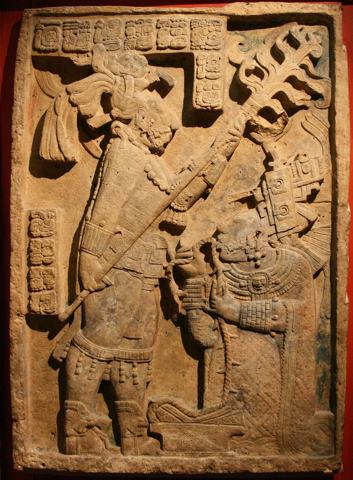
Yaxchilan Lintel 25, Late Classic Maya, dated 23 October 681 CE (British Museum) · CC0 · source
A Conduit, Not a God
The Vision Serpent is not one of the named gods of the Maya pantheon; it is a recurring image type, a doubled or single-headed snake, often bearded, sometimes with two heads facing opposite directions, whose open mouth is a doorway rather than a mouth in the ordinary sense 1,5. Schele and Miller, who first named the pattern in modern scholarship, describe it as the visual vocabulary the Classic Maya used for a moment of supernatural contact, not as a creature with its own myths, territory, or worshippers the way K'awiil or Chaac have 1.
Summoned Through Blood
The serpent appears at the climax of bloodletting rituals. Blood drawn from the tongue, ear, or genitals was caught on bark paper and burned, and the resulting smoke, combined with blood loss and often fasting, was understood to open a passage between the human world and the realm of gods and the dead 1,2. Freidel, Schele, and Parker describe the rite as a controlled trance, comparable in structure to shamanic practice recorded ethnographically among later Maya communities, in which the serpent's rearing body is the visual record of the officiant crossing into that other state 2.
What Emerges From the Jaws
What comes out of the serpent's mouth varies by monument but follows a consistent logic: an ancestor, a patron deity, or a supernatural being called a way, delivering a presence the living ruler could point to as proof of contact with the sacred 1,3. On Yaxchilan's Lintel 25, Lady K'abal Xook kneels before a vessel of burning blood-soaked paper while an enormous serpent rears above her, and from its gaping jaws a warrior ancestor emerges fully armed with spear and shield, understood as the founder of the Yaxchilan dynasty returning to sanction the current reign 3. The scene is not decorative narrative; the accompanying glyphs name the date and the participants, presenting the vision as a specific, witnessed historical event 1,3.
On Painted Vessels
The same image recurs on Classic-period painted ceramics, where Vision Serpents frame courtly scenes, coil around enthroned rulers, or disgorge deities into compositions that otherwise show entirely human courtly life 4,5. Reents-Budet's study of royal ceramic painting treats the motif as evidence that the vision-quest logic of bloodletting was not confined to monumental public ritual but pervaded the way Classic Maya elites pictured their own authority in everyday luxury objects, cups and plates made for feasting and gift exchange rather than temple display 4.
Not the Feathered Serpent
The Vision Serpent is often confused with the feathered serpent deity known in the Maya area as Kukulkan, but the two belong to different registers entirely. Kukulkan is a named, worshipped god tied to a specific cult and to Chichen Itza; the Vision Serpent is an unnamed pictorial device for a ritual event, appearing in the art of many different sites and dynasties with no single cult center or origin myth of its own 1,5. Some Vision Serpents do carry feathers or other markers borrowed from feathered-serpent iconography, which is part of why the confusion persists, but Maya artists used the two images for different purposes, and specialists caution against collapsing them into one figure 1,5.
Reading a Difficult Image
Because the Vision Serpent has no single fixed name in the surviving texts, exactly how the Classic Maya themselves distinguished one appearance of it from another, whether by species, by the identity of the being it released, or by the rite that summoned it, remains an open question, and different scholars group the images somewhat differently 1,4. What is not in doubt is the pattern's persistence: it appears on royal monuments from the fifth century through the collapse of Classic dynastic art in the ninth, making it one of the longest-running single images in the whole tradition 1,3,4.
Continue Exploring
Royal self-sacrifice of blood, through tongue or penis, the central Classic Maya rite for feeding the gods and summoning ancestors, best recorded at Yaxchilan.
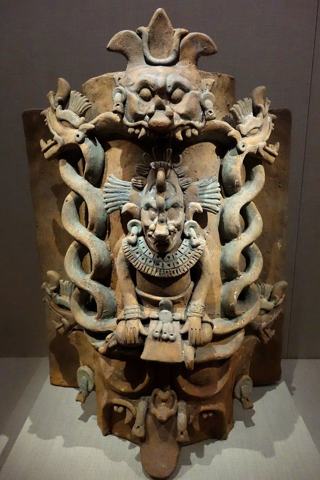
God K of the Maya codices, a deity of lightning and dynastic power whose serpent-legged, axe-browed image was the scepter every legitimate king had to hold.
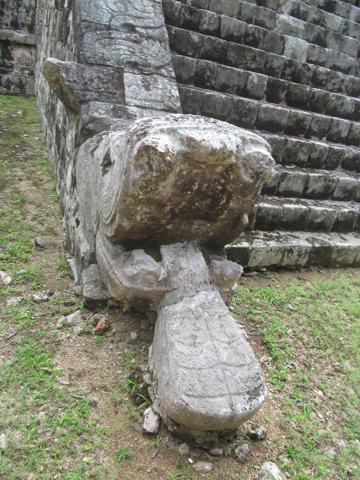
The Feathered Serpent of the Maya — creator's voice in the Popol Vuh, patron of Chichen Itza, and the shadow that descends its pyramid at the equinox.
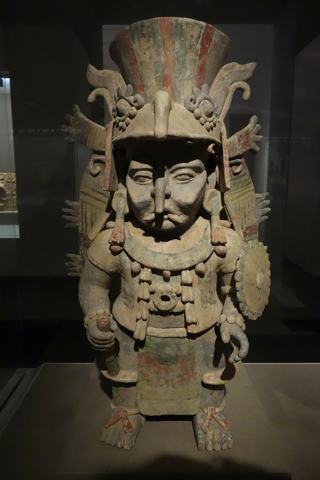
The rain god who splits the clouds with a lightning axe — one god and four, the most frequently depicted deity in the surviving Maya books.
The K'iche' Maya "Book of Council" — creation, the Hero Twins, and a dynasty's history, saved by one Dominican friar's copy of a lost original.
The aged creator — supreme sky god of the Maya, patron of writing, healing and divination, and the old man scholars know as God D.
Sources & Further Reading
- 1.Schele, Linda & Mary Miller. The Blood of Kings: Dynasty and Ritual in Maya Art. Kimbell Art Museum, 1986.
- 2.Freidel, David, Linda Schele & Joy Parker. Maya Cosmos: Three Thousand Years on the Shaman's Path. William Morrow, 1993.
- 3.Yaxchilan Lintel 25, Structure 23, Yaxchilan (Late Classic Maya, dated 23 October 681 CE; British Museum).
- 4.Reents-Budet, Dorie. Painting the Maya Universe: Royal Ceramics of the Classic Period. Duke University Press, 1994.
- 5.Miller, Mary & Karl Taube. The Gods and Symbols of Ancient Mexico and the Maya. Thames & Hudson, 1993.
Spot an error or have a source to suggest? Write to info@viseterna.com. We cite primary sources and modern scholarship, and we correct fast.