
Maya Bloodletting Rituals
Royal self-sacrifice of blood, through tongue or penis, the central Classic Maya rite for feeding the gods and summoning ancestors, best recorded at Yaxchilan.
Yaxchilan Lintel 24, Late Classic Maya, dated 28 October 709 CE (British Museum) · CC BY-SA 3.0 · source
Blood as Tribute
Classic Maya religion held that the gods had given their own blood to make and sustain humanity, and that debt had to be repaid in kind. Kings, queens, and other elites drew their own blood in ritual, offered it to images of gods and ancestors, and treated the act as the central duty of rulership rather than an occasional extremity 1,4. Schele and Miller's phrase for the whole system, "the blood of kings," names both the literal substance and the office that was obligated to shed it 1.
Instruments and the Body
The tools were specific and are well attested in burials and caches: stingray spines, shaped obsidian blades, and bone awls, used to pierce the tongue, earlobes, lips, or penis 1,4. Blood was caught on strips of bark-paper laid in a bowl, then burned with copal incense, so the offering rose to the gods as smoke rather than staying as a stain on cloth or stone 1,4. The choice of body part mattered — the tongue for speech and breath, the penis in male bloodletting rites tied to lineage and fertility — and royal women drew blood from the tongue in the best-documented cases, drawing a barbed cord through it again and again rather than a single cut 1,2.
Lady K'abal Xook and the Lintels of Structure 23
The fullest surviving record of the rite is a set of three carved lintels commissioned for Structure 23 at Yaxchilan by the ruler Itzamnaaj Bahlam III, known as Shield Jaguar, for his wife Lady K'abal Xook. Lintel 24, dated to 28 October 709 CE, shows Shield Jaguar holding a flaming torch above her while she kneels and draws a rope studded with thorns through a wound in her tongue, the blood-soaked strip already falling into a woven basket 2. The sculptor signed his work, Mo' Chaak, a rare instance of a named Maya artist 2. Lintel 26, from the same building, shows her helping him dress for battle, framing the bloodletting as one act inside a larger partnership of rule 1.
The Vision It Produced
Lintel 25, the companion panel, shows what the rite was for. Lady Xook kneels before a bowl of the blood-soaked paper she has just burned, and out of the rising smoke rears a great Vision Serpent, from whose gaping jaws a warrior ancestor emerges bearing spear and shield 3. Loss of blood, exhaustion, and the smoke of burning copal and paper together induced a trance in which the officiant was understood to see directly into the world of gods and the dead, and the carved image records that vision as a literal event rather than a metaphor 1,3,5.
Public Ritual and Political Theater
These were not private devotions. Bloodletting rites were staged at major calendrical stations, at accessions, at the dedication of buildings and monuments, and before and after war, often before an audience gathered in a temple courtyard or plaza 1,5. A ruler who could draw the Vision Serpent and produce a visible ancestor was demonstrating a claim that ordinary genealogy alone could not prove — access to the supernatural world that legitimated the right to rule and to hold the K'awiil scepter of kingship 1,4. The theatrical staging, torches, captions naming the date and participants by name, was part of the ritual's political work, not incidental to it 1,2.
Continuity and Its Limits
Bloodletting of this specific, elite, monument-recorded kind is a Classic-period phenomenon, best documented between roughly the seventh and ninth centuries and concentrated at courts like Yaxchilan, Palenque, and Copan 1,6. Related but less lavishly recorded practices, penitential piercing, offerings of blood at shrines, persisted into the Postclassic and colonial periods in less monumental forms, but the grand narrative lintels of Structure 23 have no real successor once the tradition of carved dynastic monuments itself ends 4,6. What they preserve is not a generic idea of "Maya sacrifice" but a specific, dated, named ritual performance, unusually legible because a king chose to carve it in stone.
Continue Exploring
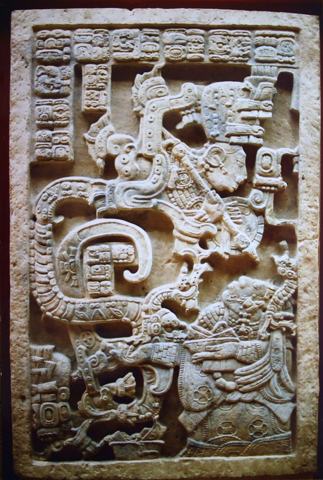
The great serpent conjured through royal bloodletting, its jaws opening to release the ancestors and gods a Classic Maya ruler needed the living to see.
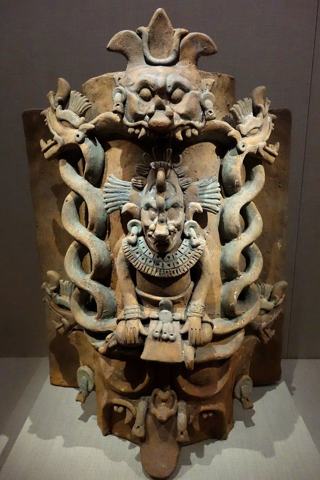
God K of the Maya codices, a deity of lightning and dynastic power whose serpent-legged, axe-browed image was the scepter every legitimate king had to hold.
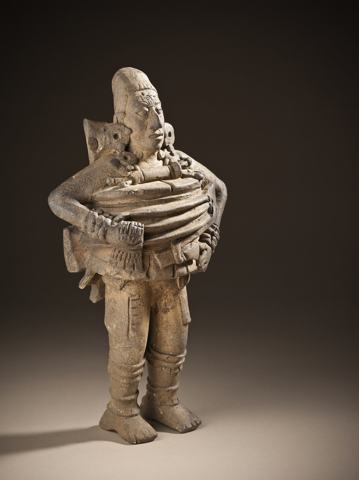
Pitz, the rubber-ball game played across the Maya world for three thousand years — real sport, staged myth, and sometimes an execution.
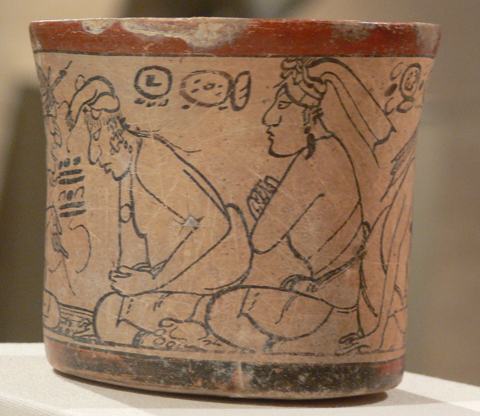
"Place of Fear" — the K'iche' Maya underworld of the Popol Vuh, a court of disease lords whose houses of trial the Hero Twins survived and overturned.
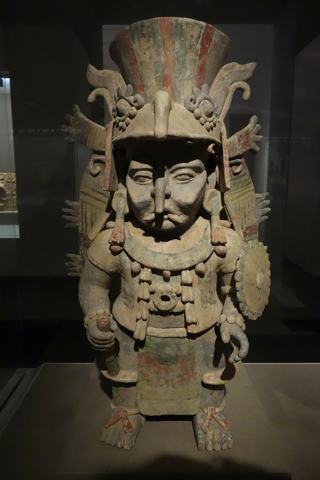
The rain god who splits the clouds with a lightning axe — one god and four, the most frequently depicted deity in the surviving Maya books.
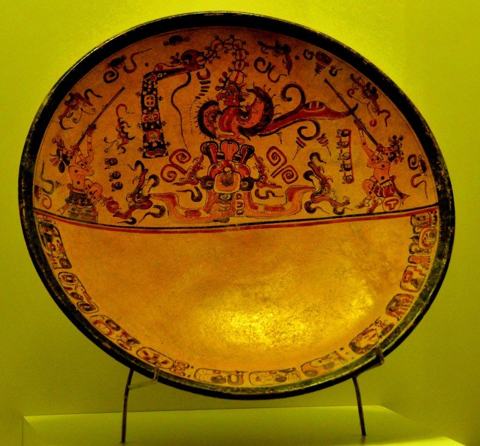
Hunahpu and Xbalanque — the ballplaying twins of the Popol Vuh who outwitted the lords of Xibalba, avenged their father, and rose as sun and moon.
Sources & Further Reading
- 1.Schele, Linda & Mary Miller. The Blood of Kings: Dynasty and Ritual in Maya Art. Kimbell Art Museum, 1986.
- 2.Yaxchilan Lintel 24, Structure 23, Yaxchilan (Late Classic Maya, dated 28 October 709 CE; British Museum).
- 3.Yaxchilan Lintel 25, Structure 23, Yaxchilan (Late Classic Maya, dated 23 October 681 CE; British Museum).
- 4.Miller, Mary & Karl Taube. The Gods and Symbols of Ancient Mexico and the Maya. Thames & Hudson, 1993.
- 5.Freidel, David, Linda Schele & Joy Parker. Maya Cosmos: Three Thousand Years on the Shaman's Path. William Morrow, 1993.
- 6.Sharer, Robert J. with Loa P. Traxler. The Ancient Maya, 6th edition. Stanford University Press, 2006.
Spot an error or have a source to suggest? Write to info@viseterna.com. We cite primary sources and modern scholarship, and we correct fast.