
The Parthenon
The Doric temple to Athena on the Athenian Acropolis, built under Pericles, decorated by Phidias, and still the most famous ruin in Greece.
The Parthenon, Frederic Edwin Church, 1871 (Metropolitan Museum of Art) · CC0 · source
Athena's House on the Rock
The Parthenon is the Doric temple built for Athena on the Athenian Acropolis, the fortified limestone outcrop that had served as the city's religious center since the Bronze Age 1,3. Its name derives from parthenos, "virgin," one of Athena's standing epithets in her role as Athens's unmarried civic protector, and the building housed both her state cult and, functionally, the treasury of the Athenian-led Delian League, making it religious monument and imperial bank vault at once 3,5. It replaced an earlier, unfinished temple on the site that Persian forces had destroyed during their sack of Athens in 480 BCE, and the Athenians deliberately left some of that destruction visible elsewhere on the Acropolis as a memorial before eventually rebuilding grander than before 3.
Pericles' Building Program
Construction began in 447 BCE under the statesman Pericles, who redirected League funds toward a building program that ancient critics, including rival politicians at the time, accused him of using imperial tribute to gild his own city, a charge Plutarch records Pericles answering by offering to pay for the buildings himself and dedicate them in his own name if the Athenians objected to the League's money funding them, at which point the assembly relented and let the public funding stand 2. The architects Ictinus and Callicrates designed the structure, an octastyle Doric temple with an unusually large interior and refined optical adjustments, entasis in the columns, a slightly convex platform, meant to correct for the human eye's tendency to see long straight lines as sagging 3,5. The sculptor Phidias held overall artistic supervision of the whole Acropolis program, working under Athena's patronage as the city's civic goddess, and Plutarch names him specifically as the figure Pericles trusted with the commission before political enemies used accusations against Phidias, over gold accounting and alleged impiety, to attack Pericles himself 2,3.
Athena Parthenos, the Lost Statue
Inside stood Phidias's Athena Parthenos, a chryselephantine (gold-and-ivory) cult statue nearly forty feet tall, its wooden core plated with ivory for Athena's skin and removable gold plates, reportedly over a ton of it, for her robe and armor, a design that let the city melt the gold down as emergency funds if truly desperate, though there is no clear record it ever was 3,5. Pausanias, visiting Athens in the second century CE, describes the statue in detail: Athena standing fully armed, a Nike (Victory) in one hand, her shield decorated with scenes of the Amazonomachy, and a serpent, representing the legendary Athenian king Erichthonius, coiled beside her shield 1,3. No original survives; the statue was lost in antiquity, likely removed to Constantinople and destroyed there, and everything known about its appearance comes from ancient written descriptions and later, much smaller Roman copies 3,5.
The Panathenaic Frieze
Running around the exterior of the temple's inner chamber, above the columns, was a continuous carved frieze some 160 meters long depicting a procession, most scholars agree it represents some version of the Panathenaic procession, the city's great annual festival honoring Athena, including riders, sacrificial animals, elders, and, on the east side, a scene of figures handling a folded cloth generally read as the presentation of a new peplos robe woven for the goddess's ancient olive-wood image 1,4. Neils's study of the frieze treats it as an idealized rather than literal record of the festival, compressing and formalizing the procession into a single timeless civic image of Athens honoring its patron deity 4. Connelly has argued for a more specific, more contested reading: that the central scene actually depicts a mythical human sacrifice tied to the legendary king Erechtheus rather than a generic peplos ceremony, a thesis that generated significant scholarly pushback and has not displaced the more conventional Panathenaic reading as the field's consensus, though it remains a live and often-cited point of disagreement 4,6.
Ruin, Survival, and Dispute
The Parthenon survived largely intact for over two thousand years, converted into a Christian church and later a mosque under Ottoman rule, before a Venetian bombardment in 1687 ignited Ottoman gunpowder stored inside the building and blew out its center, the single most destructive event in the temple's history and the source of most of the ruin visible today 3,5. In the early nineteenth century, the British diplomat Lord Elgin removed roughly half of the surviving frieze, along with metopes and pedimental sculpture, and sold them to the British Museum, where they remain on display as the "Elgin Marbles" despite decades of formal Greek requests for their return, now pressed partly through the purpose-built Acropolis Museum in Athens, completed in 2009 with a gallery designed to eventually reunite the sculptures 3,5. The building itself has been under active, reversible restoration since the 1970s, a slow, still-ongoing effort to stabilize what nearly twenty-five centuries, one massive explosion, and one imperial removal left behind 3.
Continue Exploring
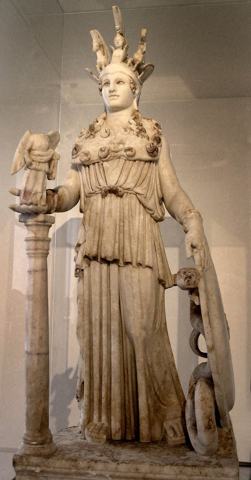
Goddess of wisdom, strategy and craft, born fully armed from the head of Zeus. Patron of Athens, of heroes, and of Odysseus above all.
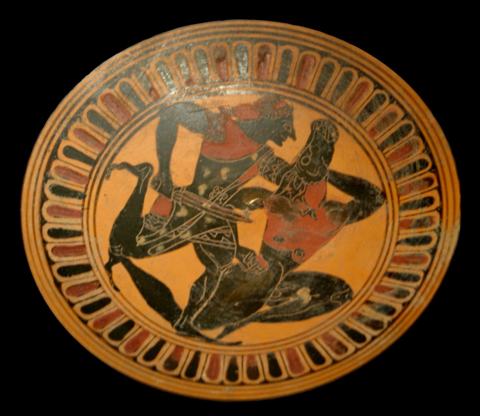
Bull of the labyrinth. The bull-headed son of a Cretan queen, hidden in a maze and fed Athenian children until Theseus followed a thread in.
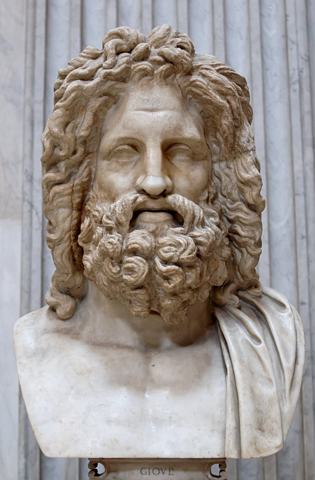
King of the gods and lord of the sky, thunder and justice. He overthrew his own father, divided the universe by lot, and guaranteed the laws of hospitality.
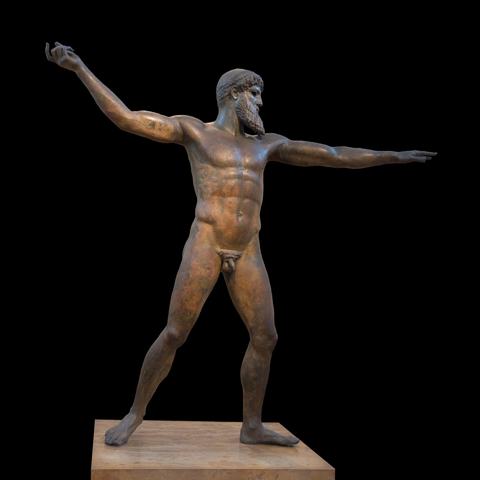
God of the sea, earthquakes and horses. Brother of Zeus, wielder of the trident, and the divine enemy who keeps Odysseus from reaching home.
King of Ithaca and the man of many turns. Homer's cleverest hero, who took ten years to sail home from Troy and had to fight for his own house.
Lord of the underworld and of the wealth beneath the earth. Not a devil — a grim, lawful king whose only rule is that no one leaves.
Sources & Further Reading
- 1.Pausanias. Description of Greece. Translated by W.H.S. Jones. Loeb Classical Library, Harvard University Press, 1918.
- 2.Plutarch. "Life of Pericles," in Plutarch's Lives. Translated by Bernadotte Perrin. Loeb Classical Library, Harvard University Press, 1916.
- 3.Hurwit, Jeffrey M. The Athenian Acropolis: History, Mythology, and Archaeology from the Neolithic Era to the Present. Cambridge University Press, 1999.
- 4.Neils, Jenifer. The Parthenon Frieze. Cambridge University Press, 2001.
- 5.Beard, Mary. The Parthenon. Profile Books, 2002.
- 6.Connelly, Joan Breton. The Parthenon Enigma: A New Understanding of the World's Most Iconic Building and the People Who Made It. Knopf, 2014.
Spot an error or have a source to suggest? Write to info@viseterna.com. We cite primary sources and modern scholarship, and we correct fast.