
Augury and the Auspices
How Roman magistrates read the will of the gods from bird-flight and lightning before every public act — the state's oldest form of applied religion.
Romulus Consulting the Augury, from The Comic History of Rome, illustrated by John Leech, 1850s · Public domain · source
What Augury Actually Was
Augury was Rome's formal method for asking whether a planned action had divine approval, practiced by a college of priests called augurs and expressed through a fixed technical vocabulary — auspicium for the observation itself, templum for the marked-out zone of sky or ground within which signs counted, and auguraculum for the platform where an augur stood to take them 5,6. It is easily confused with haruspicy, the separate Etruscan-derived practice of reading the entrails of sacrificed animals, but Roman sources keep the two distinct: augurs read the sky and the behaviour of birds, haruspices read livers, and the two colleges never merged 6,7.
Romulus, Remus, and the First Augury
Roman tradition placed the origin of the practice at the very founding of the city. Before Rome could be built, Romulus and Remus each took a position on a different hill — Remus on the Aventine, Romulus on the Palatine — to watch for birds and settle by that sign alone which of them would found the city and give it his name 3,4. The story disagrees on the details: Remus reportedly saw six vultures first, Romulus twelve slightly later, and ancient writers themselves argued over whether the greater number or the earlier sighting should have won, a dispute later authors present as the direct spark for the quarrel that ended with Remus dead at his brother's hand 3,4. The same foundation story gave its name to a separate February rite, the Lupercalia, run at the cave where Lupa was said to have nursed the twins, at the foot of the same hill where Romulus stood watching the sky 4.
Reading the Sky
An augur did not simply wander outdoors and wait. He first marked out a templum, a field of vision oriented to the cardinal points, using his curved staff, the lituus, to fix its boundaries in the air; only signs occurring inside that defined space counted as valid 5,8. Within it he watched for two broad categories the Romans called alites, birds whose flight and position mattered, and oscines, birds whose cry mattered, with different species carrying different and sometimes conflicting significance — the eagle and the vulture were alites of the first importance, the raven and the owl oscines parsed as favourable or not depending on the direction their call came from 6,8. A related but distinct sign came from the sacred chickens kept by the army for the tripudium: taken on campaign specifically so a commander could watch whether they ate their feed eagerly before battle, a refusal to eat was treated as a bad omen no commander could safely ignore, at least in public 3,8.
No Public Act Without It
By the middle Republic, augury was a formal precondition for nearly every act of state rather than a private curiosity. Elections, the passage of laws, and the departure of armies for war all required that the auspices be taken and found favourable first, and a magistrate who acted despite unfavourable signs, or without taking them at all, exposed his actions to being challenged or annulled after the fact 2,6. That created an obvious opening for politics to hide inside religion: a magistrate hostile to a piece of legislation could announce he was "watching the sky" (obnuntiatio) for omens, which by convention suspended business whether or not he had actually seen anything — the consul Bibulus spent much of 59 BC doing exactly this against his colleague Julius Caesar, with limited practical effect but lasting notoriety 1,6,8.
Cicero the Skeptical Augur
The single most revealing ancient source on augury is also its most conflicted. Cicero was himself an augur, elected to the college in the late 50s BC, and yet his treatise De Divinatione argues at length, in his own voice, that divination in general has no genuine predictive power and survives mainly as a useful social and political discipline 1. He is not shy about the tension: augury, he suggests, is worth maintaining as a check on rash public action and a mark of Roman tradition, whatever one privately concludes about whether birds actually carry messages from the gods 1,7. Modern historians generally read this not as hypocrisy but as an accurate picture of how Roman elite religion worked in practice — a shared civic vocabulary that did not require uniform private belief in order to function 6,7.
After the Republic
Augury survived the fall of the Republic formally intact; emperors were augurs, and the college continued to exist for centuries. But its political bite — the power of a magistrate's obnuntiatio to stop the business of state — was largely defused once power concentrated in one man who no longer needed to fear a rival's veto 6,8. Like the rest of Rome's traditional priesthoods, the augurate lost state funding under the emperor Gratian in AD 382 and faded within a generation, leaving behind mainly its vocabulary: "auspicious," "inaugurate," and templum itself all descend directly from the technical language of watching Roman skies for permission to act 6.
Continue Exploring
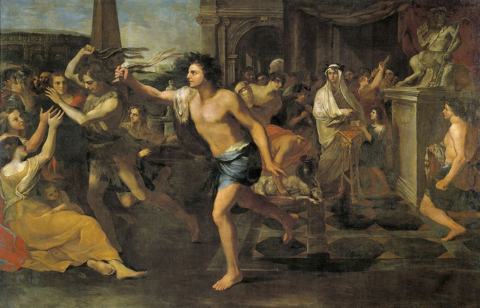
Rome's February fertility rite at the wolf's cave, where near-naked priests struck bystanders with goat-hide thongs — its link to Valentine's Day is unproven.
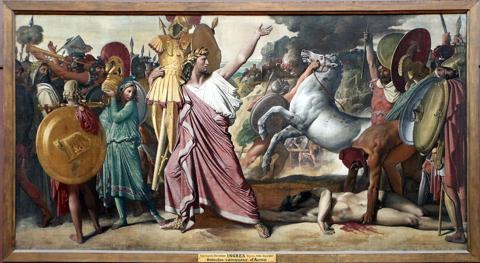
Twin sons of Mars, saved by a she-wolf and raised by shepherds, who quarreled over where to found Rome — a quarrel that ended with only one of them ruling it.
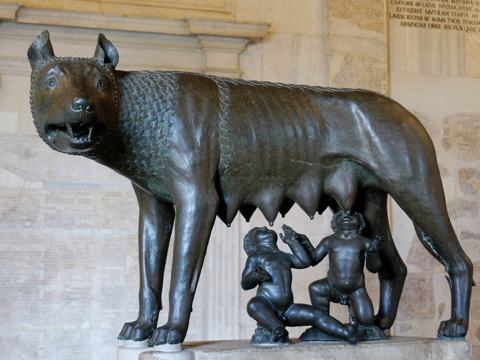
The she-wolf of Rome — the beast that suckled the abandoned twins Romulus and Remus, and the most durable emblem the city ever gave itself.
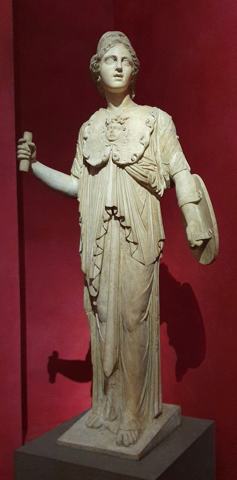
The wooden image of Pallas Athena said to guard Troy, stolen by the Greeks and, by Roman legend, carried to Italy by Aeneas to protect Rome instead.
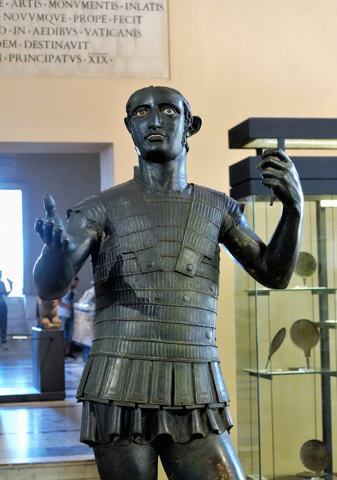
God of war and father of Rome — honoured above almost every other deity, with his own month, his own dancing priests, and the twins he fathered on a Vestal.
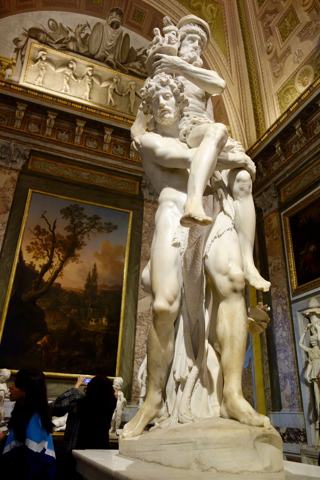
The Trojan prince who escaped burning Troy carrying his father and household gods, wandered the Mediterranean, and became Rome's mythical ancestor.
Sources & Further Reading
- 1.Cicero, De Divinatione (44 BC).
- 2.Cicero, De Legibus — Book II (52-43 BC).
- 3.Livy, Ab Urbe Condita — Book I.18, 36.
- 4.Dionysius of Halicarnassus, Roman Antiquities — Book II.5-6.
- 5.Festus, De Verborum Significatu (2nd century AD epitome of Verrius Flaccus).
- 6.Beard, Mary, John North and Simon Price. Religions of Rome. 2 vols. Cambridge University Press, 1998.
- 7.Rüpke, Jörg. Religion of the Romans. Trans. Richard Gordon. Polity, 2007.
- 8.Linderski, Jerzy. "The Augural Law." Aufstieg und Niedergang der römischen Welt II.16.3, 1986.
Spot an error or have a source to suggest? Write to info@viseterna.com. We cite primary sources and modern scholarship, and we correct fast.