
The Four Symbols
The four beasts of the Chinese sky — dragon, tiger, bird and tortoise-and-snake. A star map first, a mythology second, and both for over two thousand years.
Pottery tile with the cardinal directions, Han dynasty (Musee Cernuschi, Paris); photograph by Guillaume Jacquet, 2006 · CC BY-SA 3.0 · source
Four Beasts, Four Quarters
The Four Symbols — Si Xiang (四象), also called the Four Celestial Beasts or Four Guardians — are the animals that divide the Chinese sky and, by extension, the world:
- Qinglong, the Azure Dragon of the East — spring, wood, the colour blue-green 3,4.
- Baihu, the White Tiger of the West — autumn, metal, white 3,4.
- Zhuque, the Vermilion Bird of the South — summer, fire, red 3,4.
- Xuanwu, the Dark or Black Warrior of the North — winter, water, black, and depicted not as a single beast but as a tortoise entwined with a snake 3,4.
They are frequently completed by a fifth term at the centre — the Yellow Dragon or, in some schemes, the qilin — because the correlative system they belong to has five phases rather than four 3,5. The four-plus-centre arrangement is the one shown on Han tomb tiles and mirror backs 5,6.
Astronomy First
The Four Symbols are best understood as a piece of observational apparatus. Chinese astronomers divided the band of sky along the celestial equator and ecliptic into twenty-eight lunar mansions (xiu), uneven segments used to fix the positions of the moon, sun and planets 4,5. The twenty-eight were grouped into four "palaces" of seven, and each palace was given an animal shape — the string of mansions in the east read as a dragon, those in the west as a tiger, those in the south as a bird, those in the north as a tortoise 4,6.
Sima Qian's Treatise on the Celestial Offices sets out the mature Han version of the system, with the palaces, their constellations and their portents 4. Needham argued that the Chinese equatorial-polar scheme, organised around circumpolar stars and mansions rather than the zodiacal ecliptic of the Greek tradition, is one of the genuinely independent astronomical systems of antiquity 5; Sun and Kistemaker's reconstruction of the Han sky maps the mansions and their asterisms in detail and shows how tightly the imagery is fitted to the star groups 6.
The archaeology reaches back further than the texts. The lacquer chest from the tomb of Marquis Yi of Zeng, sealed around 433 BC, carries the names of all twenty-eight mansions around a central Dipper graph, flanked by a dragon and a tiger 1. That the eastern and western animals are present and the other two are not has been read as evidence that the dragon-tiger pair is the older core and the full set of four a later completion, though the object is a single find and the inference is not secure 1,6.
Direction, Season and the Ordered World
Once fixed, the four animals were absorbed into the correlative cosmology that organises so much of Han thought: direction, season, phase, colour, note, organ and virtue all lined up in columns, with the beasts as the visible markers of the columns 3. The Huainanzi gives one of the fullest statements of the scheme 3.
The Liji preserves a practical use older than the cosmology: on the march, an army is to carry the Vermilion Bird in front, the Dark Warrior behind, the Azure Dragon on the left and the White Tiger on the right — which is a way of saying south, north, east and west when facing south, and also a way of keeping formation 2. The four appear as protective figures on Han and later tomb architecture, on eaves tiles, on bronze mirrors and on funerary banners; the Tang-period tomb murals of Korea and Japan, such as those at Takamatsuzuka, carry the same programme, which is one of the clearest markers of how far the system travelled 5,6.
Chinese geomancy inherited it wholesale. The classic fengshui site description — dragon on the left, tiger on the right, bird before, tortoise behind — is the same orientation applied to a landscape rather than a sky 5.
Mythological Readings
Whether the Four Symbols are gods is a fair question and the honest answer is: increasingly, but not originally. In the Han sources they are cosmic markers and omen-bearers rather than persons with biographies 4,5. Daoist liturgy then took them up as guardian generals of the four quarters, invoked by name in protective rites, and it is at this stage that they acquire titles, ranks and personal names 5.
Xuanwu is the striking case. From a directional emblem the northern figure develops into Zhenwu, the Perfected Warrior — a major Daoist deity with his own hagiography, an imperial cult under the Ming, and the great temple complex on Mount Wudang; the tortoise and snake become demons he has subdued and carries as attendants 5. That is a full mythological career grown out of a star-map convention, and it is the exception rather than the pattern. Modern popular culture tends to treat all four as though they had reached that level; the sources do not support it for the dragon, tiger and bird to anything like the same degree 4,5.
Not the Same as the Four Numinous Creatures
A persistent confusion is worth naming. The si ling, the four numinous creatures of the Liji — dragon, phoenix, tortoise and qilin — are a set of auspicious omen-beasts, not directional guardians, and the fenghuang is not the Vermilion Bird, though the two are conflated constantly in retellings and sometimes in later art 2,5. The dragon of the eastern palace likewise overlaps with, but is not identical to, the rain-bringing dragons of popular religion described under the Chinese dragon 4,5.
Their afterlife is enormous: the four turn up as elemental factions, guardian summons and boss quartets across East Asian fiction, animation and games, usually under the Japanese readings Seiryu, Byakko, Suzaku and Genbu 5,6. What almost never survives the translation is the original point — that these are the shapes people put on stars in order to find them again next year 4,6.
Continue Exploring
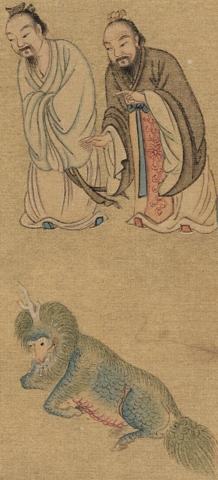
The gentle omen-beast of Chinese myth — scaled, horned, treading on no living thing. It appears when a sage rules, and its capture foretold Confucius' death.
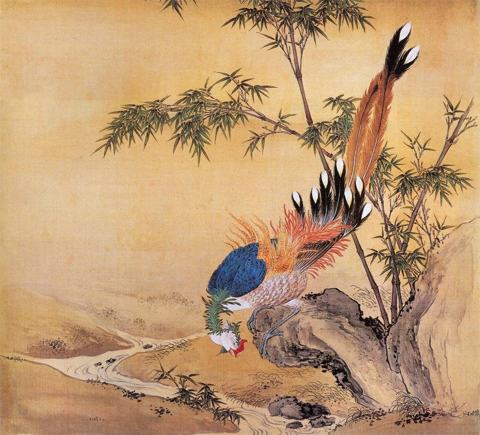
The radiant bird of Chinese myth — ruler of all birds, marked with the five virtues, whose rare appearance announces a just reign and an age of peace.
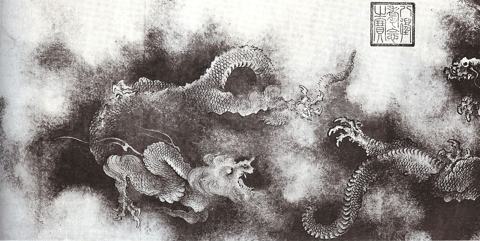
China's dragon — a benevolent, scaled power of rain, river, and sea, emblem of imperial authority and the only mythical beast in the zodiac.
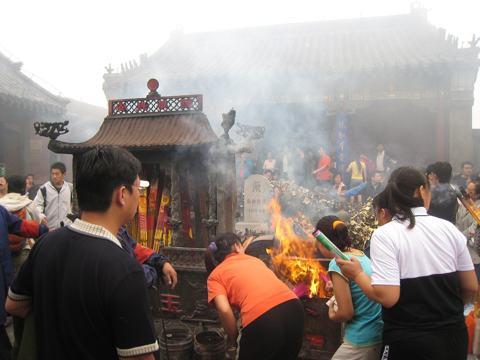
China's most sacred mountain, climbed by emperors seeking Heaven's mandate and by pilgrims for three millennia — seat of a goddess and an underworld judge.
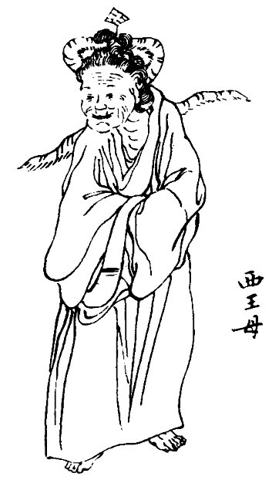
China's oldest surviving catalogue of mountains, monsters, and gods — a text nobody can name an author for, and half this Codex's bestiary depends on.
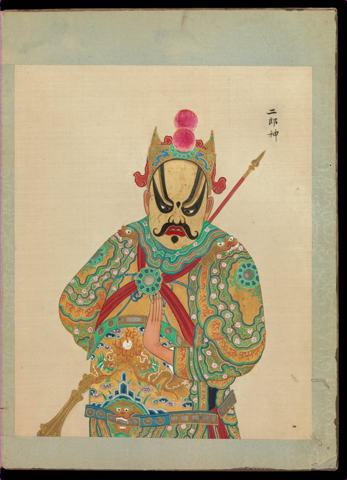
The three-eyed god of Guankou who tamed the floods and was the only celestial general able to beat the Monkey King in a fair fight.
Sources & Further Reading
- 1.Lacquer clothes chest from the tomb of Marquis Yi of Zeng, c. 433 BC (Hubei Provincial Museum) — dipper, twenty-eight mansion names, dragon and tiger.
- 2.Liji (Book of Rites), 'Quli' — the marching banners of bird, tortoise, dragon and tiger (compiled Han dynasty).
- 3.Huainanzi, 'Tianwen' chapter (139 BC) — the five directions and their correlates.
- 4.Sima Qian, Shiji, 'Tianguan shu' (Treatise on the Celestial Offices), c. 91 BC.
- 5.Needham, Joseph. Science and Civilisation in China, Vol. 3: Mathematics and the Sciences of the Heavens and the Earth. Cambridge University Press, 1959.
- 6.Sun Xiaochun and Jacob Kistemaker. The Chinese Sky During the Han: Constellating Stars and Society. Brill, 1997.
Spot an error or have a source to suggest? Write to info@viseterna.com. We cite primary sources and modern scholarship, and we correct fast.