
Qilin
The gentle omen-beast of Chinese myth — scaled, horned, treading on no living thing. It appears when a sage rules, and its capture foretold Confucius' death.
Confucius identifying a qilin during a hunt, from an album of anecdotes from the life of Confucius, 18th-19th century, after Qiu Ying and Wen Zhengming · Public domain · source
What a Qilin Is
The qilin (麒麟) is the auspicious beast of Chinese tradition, routinely rendered in English as "Chinese unicorn" — a translation that captures the single horn and almost nothing else 5. The name is a compound: early lexicography treats qi as the male and lin as the female of the species, and the older texts usually say simply lin 4.
Descriptions vary by period and never settle. The recurring elements are a hooved, deer-like or ox-like body under scales, a bushy tail, flames or clouds at the shoulders, a dragon's head, and one horn — sometimes two, sometimes a horn tipped with flesh so that it cannot wound 4,5. Later art assimilates it steadily toward the Chinese dragon, which is why Ming and Qing qilin often look scaled and whiskered rather than deer-like 5.
The Gentlest Monster
What distinguishes the qilin in Chinese thought is not power but restraint. It is said to eat no living thing, to tread so carefully that it crushes neither insect nor growing grass, and to harm nothing even in self-defence 4,5. Its voice is described as musical, tuned to the pitch pipes. It lives a thousand years or more and appears only rarely.
That rarity is the point. The qilin belongs to the class of ruiying — responsive auspices, creatures and phenomena that manifest when government is virtuous and withdraw when it is not 5. Sterckx's study of animals in early China stresses how thoroughly this logic ran: beasts in the classical texts are not a separate natural order but a register in which the moral state of the human world is read back 5. A qilin sighted is therefore a political statement, and one that later dynasties were very willing to have made about them.
The Liji groups the qilin with the phoenix, the tortoise and the dragon as the si ling, the four numinous creatures whose presence marks a well-ordered realm 3. This set overlaps with, but is not the same as, the directional animals of the Four Symbols — a distinction modern retellings frequently blur 3,5. The qilin's usual pairing in decorative art is with the fenghuang, the Chinese phoenix.
The Capture of the Lin
The most consequential qilin story is a failure. The Chunqiu, the terse annals of the state of Lu traditionally associated with Confucius, records that in the fourteenth year of Duke Ai a hunt in the west "caught a lin" 1. The Zuo zhuan elaborates: the animal was taken by a woodcutter, thought unlucky, and cast aside; Confucius came to look at it and identified it 1.
Tradition made this the hinge of his life. A qilin had come in a degenerate age and been killed by people who did not know what it was — the auspice arriving with no sage on the throne to justify it — and Confucius is said to have wept and to have ended the Chunqiu at that entry 1. The episode gave classical Chinese the phrase huo lin, "catching the lin", for a final work or an end of things. Whether Confucius said any of it is unrecoverable; the anecdote is the tradition speaking about itself, and it is best read that way 1,5.
The Shijing preserves an older and warmer use. Ode 11 praises a noble house through the lin's feet, forehead and horn, taking the creature as a figure for well-bred and harmless offspring — evidence that the qilin was a familiar emblem of virtue long before the philosophical apparatus grew up around it 2.
Bringing Sons, and a Giraffe
Popular religion put the qilin to work. Qilin song zi — "the qilin brings a son" — is one of the most common auspicious images in Chinese art: a child, often holding a lotus or a sheng pipe, riding the beast. A legend attached to Confucius' own birth has a qilin appear to his mother and spit out a jade tablet, and by late imperial times a promising boy was flatteringly called a "qilin child" 5.
The strangest chapter came in 1414, when a giraffe reached the Ming court, sent from Bengal and acquired on the maritime expeditions associated with Zheng He; further giraffes followed from the East African coast 6. Courtiers presented the animal as a qilin and composed encomia treating its arrival as heaven's endorsement of the Yongle emperor, a ruler with a usurpation to legitimise 6. Church's study of the episode argues the identification was not naive zoology so much as available diplomacy, and notes that the Yongle emperor himself is recorded deflecting the flattery 6. The Korean word girin and the Japanese kirin still mean both the mythical beast and, in modern usage, the giraffe 6.
The Qilin Since
The qilin survives in forms that have drifted far from the classics: stone qilin flanking temple and tomb approaches, qilin badges on Ming and Qing military court robes, the qilin dance of Hakka communities, and a steady presence in Japanese and Korean art under the local readings of the name 5,6. Modern fantasy fiction, film and games have generally kept the horn and the flames while quietly dropping the vegetarian ethics that were the whole substance of the creature 5.
It remains, in its original sense, one of the few monsters anywhere defined by an incapacity for harm — closer in spirit to the recluse-sages of Chinese tradition than to the beasts it is usually shelved beside 5.
Continue Exploring
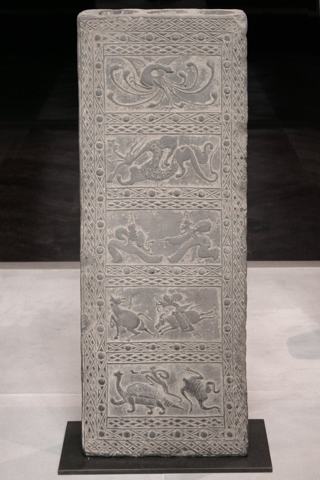
The four beasts of the Chinese sky — dragon, tiger, bird and tortoise-and-snake. A star map first, a mythology second, and both for over two thousand years.
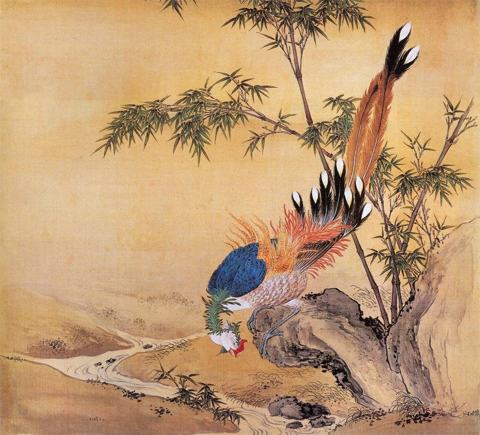
The radiant bird of Chinese myth — ruler of all birds, marked with the five virtues, whose rare appearance announces a just reign and an age of peace.
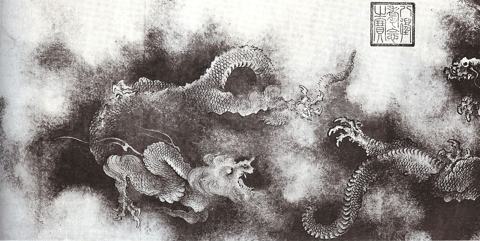
China's dragon — a benevolent, scaled power of rain, river, and sea, emblem of imperial authority and the only mythical beast in the zodiac.
China's oldest surviving catalogue of mountains, monsters, and gods — a text nobody can name an author for, and half this Codex's bestiary depends on.
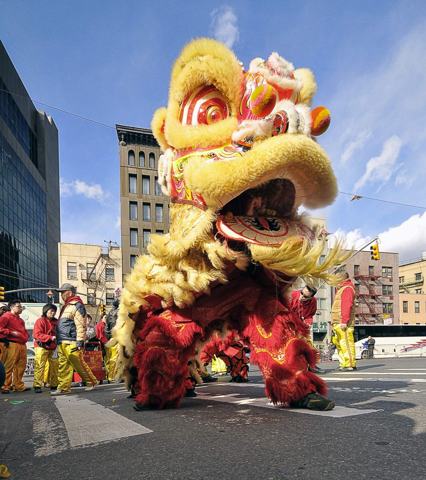
The horned beast said to terrorize villages once a year until scared off by firecrackers, fire, and red — a legend newer than the New Year customs it explains.
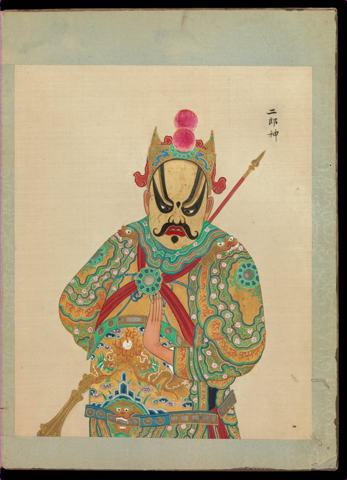
The three-eyed god of Guankou who tamed the floods and was the only celestial general able to beat the Monkey King in a fair fight.
Sources & Further Reading
- 1.Chunqiu (Spring and Autumn Annals) and Zuo zhuan, Duke Ai year 14 — the capture of the lin (traditionally 481 BC).
- 2.Shijing (Book of Odes), Ode 11, 'Lin zhi zhi' — the feet of the lin (c. 1000-600 BC).
- 3.Liji (Book of Rites), 'Liyun' chapter — the four numinous creatures (compiled Han dynasty).
- 4.Xu Shen, Shuowen jiezi (Explaining Graphs and Analysing Characters), c. AD 100 — entries for qi and lin.
- 5.Sterckx, Roel. The Animal and the Daemon in Early China. State University of New York Press, 2002.
- 6.Church, Sally K. 'The Giraffe of Bengal: A Medieval Encounter in Ming China.' The Medieval History Journal 7.1 (2004), 1-37.
Spot an error or have a source to suggest? Write to info@viseterna.com. We cite primary sources and modern scholarship, and we correct fast.