
Hachiman
Kami of war, archery and the bow, patron of the samurai and the first kami titled a bodhisattva, worshipped at tens of thousands of shrines.
Sogyo Hachiman (Hachiman in monk's form), Kaikei, 1201 (Todaiji, Nara); plate from Japanese Temples and their Treasures, 1915 · Public domain · source
From a Kyushu Hillside to the Court
Hachiman is one of the most widely enshrined kami in Japan — the count of Hachiman shrines is usually given in the tens of thousands, second only to Inari — and unlike most of the great deities he is almost entirely absent from the eighth-century mythological chronicles 4,7. He does not appear in the Kojiki's age of the gods, and the Nihon Shoki never uses his name. His cult can be traced instead to a specific place: Usa, in Buzen province in northern Kyushu, where a local deity worshipped by the Usa and Karashima clans was given an official shrine in the early eighth century 4,5.
The name is written with the characters for "eight banners", read yahata in older usage before the Sino-Japanese reading Hachiman prevailed. Its origin is uncertain; explanations from eight banners raised at a divine birth to a connection with the loom and with immigrant weaving lineages have all been offered, and none is decisive 4,6. What is clear is that the Usa cult absorbed continental and Buddhist elements early, and that its priesthood included shamanic mediums who delivered the deity's oracles — the mechanism through which Hachiman would repeatedly intervene in national politics 5,7.
Identification with Emperor Ojin
Between the Nara and Heian periods, Hachiman came to be identified with the spirit of Ojin, the fifteenth sovereign in the traditional imperial count, and thereby with the imperial ancestry itself 4,7. The Nihon Shoki tells of Ojin's mother, the Empress Jingu, campaigning in Korea while pregnant with him and delaying the birth by binding a stone to her waist — a legend that gave the later Hachiman cult both its martial character and its role in safe childbirth 1,4. Most Hachiman shrines enshrine a triad: Ojin as Hachiman, Jingu as his mother, and a female deity or group of deities usually called Himegami 4,7.
Modern scholarship treats the identification with Ojin as a construction of the eighth and ninth centuries rather than an ancient fact, part of the process by which a provincial deity was drawn into the service of the Yamato state 4,5. Once made, the equation held: an ancestral emperor who was also a war god was extraordinarily useful to anyone claiming legitimate authority.
The Great Buddha and the Bodhisattva Title
In 749 the court of Emperor Shomu was struggling to complete the colossal bronze Buddha at Todaiji in Nara. An oracle from Usa declared that Hachiman would lead the kami of heaven and earth to see the work finished, and the deity was conveyed in state to the capital — carried in a purple palanquin, received with court music, and installed on the hill above the temple 2,4. It is the founding event of honji suijaku, the medieval framework in which kami were understood as local manifestations of buddhas and bodhisattvas, and Hachiman was its first and most important case 6,7.
In 781 Hachiman received the title Daibosatsu, "Great Bodhisattva" — the first kami so honoured 2,4. The consequence for religious art was immediate and lasting. Hachiman is depicted as Sogyo Hachiman, the deity in the robes and shaven head of a Buddhist monk, seated with a staff; Christine Guth Kanda's study traces the type from ninth- and tenth-century wooden images to the celebrated painted statue carved by Kaikei for Todaiji in 1201 4. That a war god should be shown as a tonsured monk is one of the more striking visual paradoxes in Japanese religious sculpture.
Hachiman intervened again in 769. The monk Dokyo, having risen to extraordinary influence under Empress Shotoku, was reportedly the beneficiary of an oracle from Usa declaring that he should take the throne. The court sent Wake no Kiyomaro to verify it; he returned with a counter-oracle stating that only a member of the imperial line might rule, and Dokyo's ambitions collapsed 2,5. Ross Bender's study of the episode argues that the affair reveals how far Hachiman's oracles had become a recognised instrument of court politics — a channel through which factions could contest the succession in the deity's voice 5.
The God of the Samurai
In 859 the monk Gyokyo brought Hachiman from Usa to Otokoyama, southwest of the capital, founding Iwashimizu Hachimangu as a tutelary shrine for Kyoto and for the imperial house 4,7. From there the cult passed to the warrior class. The Seiwa Genji, the branch of the Minamoto descended from Emperor Seiwa, adopted Hachiman as their clan deity: Minamoto no Yoriyoshi founded a Hachiman shrine at Kamakura in 1063, and his son Yoshiie was capped at Iwashimizu and known ever after as Hachiman Taro, "Hachiman's eldest son" 4,7.
When Minamoto no Yoritomo established his warrior government at Kamakura, he rebuilt that shrine on a grand scale as Tsurugaoka Hachimangu and made it the ritual centre of the new regime 4,7. Hachiman thereby became the god of the samurai as a class, and the cult spread with warrior landholding across the country — which is the practical reason there are so many Hachiman shrines today 4,6. His attributes are the bow and arrow; the New Year hamaya, the "demon-quelling arrow" sold at shrines, and the doves that serve as his messengers both belong to this complex 4,7.
Later tradition credited Hachiman, along with other kami, with the storms that wrecked the Mongol fleets in 1274 and 1281, and the medieval text Hachiman gudokun elaborates the deity's protective role in the invasions at length 3,4. The oracle collection compiled at Usa in 1313 shows how thoroughly, by then, the deity's authority rested on his recorded speech 3.
Hachiman Since
The Meiji separation of kami and buddhas in 1868 stripped the Buddhist apparatus from Hachiman shrines — the Daibosatsu title was formally dropped and monk-form images were removed from worship halls — and the state cult of the modern period emphasised his martial and imperial aspects, a use of the god that scholars generally treat as a deliberate reframing rather than a continuation 6,7. Since 1945 Hachiman shrines have returned to a broadly civil role: Iwashimizu, Usa and Tsurugaoka remain major pilgrimage sites, and the deity is petitioned for success, safe childbirth and protection more often than for victory in battle 7.
Continue Exploring
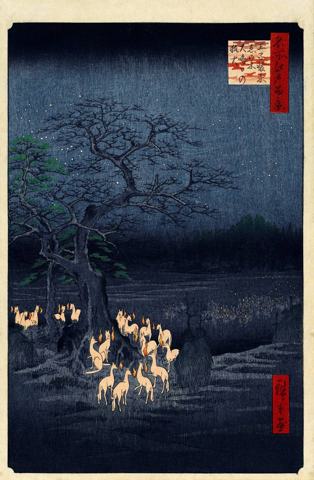
Kami of rice, sake and worldly prosperity, served by white foxes and worshipped at roughly a third of all Japanese shrines.
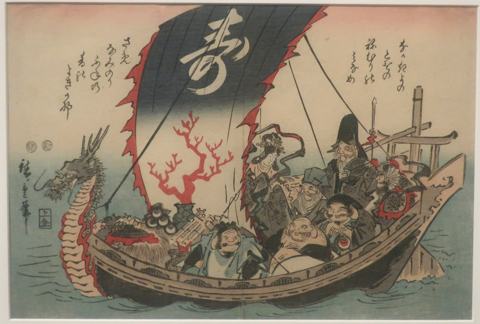
Seven mismatched deities of luck, drawn from native, Buddhist, Hindu and Taoist sources, who ride together on a treasure ship and visit New Year's dreams.
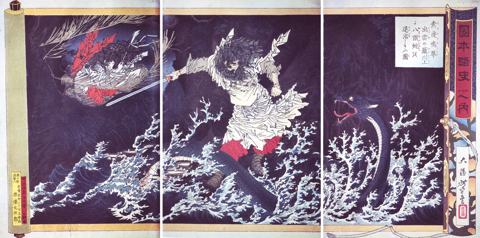
The raging kami of sea and storm — expelled from heaven for wrecking his sister's fields, then redeemed in Izumo by slaying an eight-headed serpent.
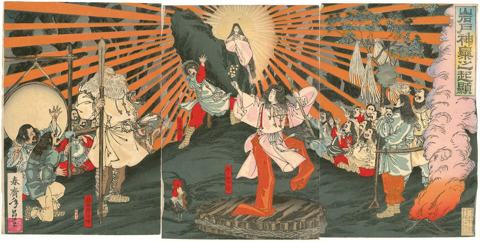
The sun goddess who shines in heaven — ruler of the Plain of High Heaven, ancestor of Japan's imperial line, and the kami enshrined at Ise.
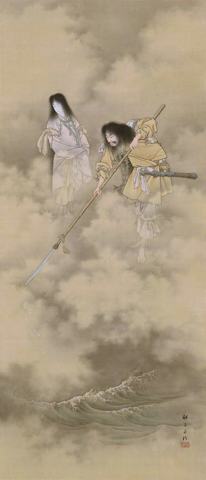
The creator pair of Japanese myth: they stirred the first island out of the sea, bore the land itself, and were parted forever by death.
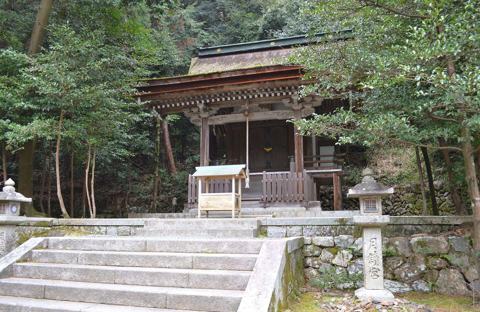
The moon kami born from Izanagi's right eye — ruler of the night, whose single recorded act of violence set the sun and moon forever apart.
Sources & Further Reading
- 1.Nihon Shoki (Chronicles of Japan, 720) — the reigns of Empress Jingu and Emperor Ojin, in W.G. Aston (trans.), Nihongi. Kegan Paul, 1896.
- 2.Shoku Nihongi (Chronicles of Japan Continued, 797) — the Usa oracles of 749 and 769.
- 3.Hachiman Usa-gu gotakusenshu (Collected Oracles of the Hachiman Shrine at Usa, compiled 1313).
- 4.Kanda, Christine Guth. Shinzo — Hachiman Imagery and its Development. Harvard University Press, 1985.
- 5.Bender, Ross. "The Hachiman Cult and the Dokyo Incident." Monumenta Nipponica 34, no. 2 (1979), 125-153.
- 6.Teeuwen, Mark, and Fabio Rambelli (eds.). Buddhas and Kami in Japan — Honji Suijaku as a Combinatory Paradigm. RoutledgeCurzon, 2003.
- 7.Breen, John, and Mark Teeuwen. A New History of Shinto. Wiley-Blackwell, 2010.
Spot an error or have a source to suggest? Write to info@viseterna.com. We cite primary sources and modern scholarship, and we correct fast.