
Saturnalia
Rome's December festival of role reversal and gifts, when slaves dined with masters and the freedman's cap was worn by all — likely not the root of Christmas.
Saturnalia, Antoine-François Callet, 1783 · CC0 · source
A Roman December
The Saturnalia opened on 17 December, the dedication day of the temple of Saturn at the western end of the Forum, and by the time our best account of it was written the holiday was already centuries old 1. That account is Macrobius's Saturnalia, a dialogue set at a Roman dinner party during the festival itself, composed in the early fifth century AD — a late, Christian-era antiquarian looking back at a pagan holiday that had by his own day already outlived the political system that produced it 1. Modern historians treat him with some caution for exactly that reason: he is collecting and systematizing older material rather than reporting as an eyewitness, and some of what he presents as ancient custom may be his own tidying-up of a messier tradition 7.
The date itself was fixed, but the festival's length was not. Roman sources describe it growing from a single day to three and then, under pressure from both directions, toward a full week; Augustus tried to cap the public holiday at three days, and Caligula pushed it longer, a tug-of-war Macrobius records with some amusement 1.
The World Turned Upside Down
For the length of the festival, Rome's social machinery ran in reverse. Formal togas were set aside for loose dinner-dress, courts and schools closed, gambling was tolerated in public, and every free man wore the felt pilleus, the cap normally reserved for a newly freed slave 1,2. Statius describes the emperor Domitian presiding over a Saturnalia banquet thrown open to the whole population of Rome, with food and gifts distributed regardless of rank — a poem that is as much flattering imperial propaganda as reportage, but one that shows how far up the social scale the festival's logic of universal license was expected to reach 2.
Inside individual households the reversal went further still. Masters were said to serve their slaves at table, or at least let them eat first and speak with a freedom that would otherwise have been punished, while a temporary "king" of the revels, chosen by lot, issued absurd commands the rest of the household had to obey 1. Lucian's Saturnalia, written in Greek about the parallel festival there, the Kronia, goes furthest of any surviving text in spelling the rules out as a kind of comic legal code: master and slave share a table, and for the length of the holiday a slave may tell his master exactly what he thinks of him, before returning to ordinary servitude when it ends 4.
Gifts, Candles, and Noise
The festival's other signature was the exchange of small presents, chiefly wax candles (cerei) and little clay or dough figurines called sigillaria, passed between friends and patrons to the standing greeting io Saturnalia 1. Martial's fourteenth book of Epigrams is effectively a shopping catalogue in verse: over two hundred short poems, each written to be tied to a specific Saturnalia gift — dice, writing tablets, a toothpick, a parrot, a cheap copy of Virgil — giving a far more concrete sense of what actually changed hands than any formal religious source does 3.
Not every Roman enjoyed the noise that came with it. Pliny the Younger, describing his seaside villa at Laurentum, boasts of a bedroom set far enough from the slaves' quarters that he can hear nothing of the festival's shouting even while it is happening under the same roof — a small, telling admission that for the master of a house the licensed uproar of December was sometimes simply uproar 5.
Saturn's Rule, Briefly Restored
The Romans connected this reversal to a specific myth. Saturn was remembered as the god who had once ruled Italy during a lost Golden Age of natural abundance and rough social equality before he was displaced, and the Saturnalia's suspension of ordinary hierarchy has long been read by scholars as a brief, licensed re-enactment of that vanished world, with slavery and status put on hold for a week and then resumed exactly as before 1,6. Macrobius makes the connection explicit and adds a detail that reinforces it: the cult statue of Saturn in his temple stood bound at the feet with woollen fetters all year, and the bonds were loosed only for the days of the festival 1.
Not the Origin of Christmas
A claim repeated constantly online is that Christmas is simply the Saturnalia relabelled, or that 25 December was chosen specifically to overwrite the Roman festival. Both halves of that claim are weaker than the confidence with which they are usually stated. The Saturnalia itself ran from 17 to 23 December at its longest and never included the 25th; the later imperial festival actually anchored on the winter solstice was Sol Invictus, established as a state cult only in the third century AD, decades after the earliest evidence for Christians marking Christ's birth in December 8. Hijmans, who has studied the Sol Invictus cult closely, argues that the tidy causal story often repeated — a sun-god festival deliberately swapped for the Nativity — rests on thin and late evidence, and that the two calendar dates may simply have converged without one directly producing the other 8.
What is fair to say is looser. Winter, in a Mediterranean society without electric light, was already a natural season for a licensed, food-and-gift-centred holiday, and several unrelated late-antique traditions cluster in the same few weeks for that reason rather than because one was built to replace another 6,7. The genuinely well-evidenced borrowings — a fixed midwinter date, gift-giving, candles, general festivity — are real enough to explain the popular association, without requiring the single deliberate act of replacement that the ancient sources do not actually describe 1,8.
After Rome
The festival did not survive as a pagan rite much past the fourth century, as Christian emperors withdrew state support from the traditional cults generally 6. Its name outlived it. "Saturnalia" remains the standard shorthand in English for any bout of licensed disorder, and its specific customs — a mock king, reversed table service, small novelty gifts among friends — resurfaced independently in medieval and early modern midwinter traditions such as the Lord of Misrule and Twelfth Night, which scholars generally treat as separate developments rather than unbroken survivals of the Roman rite 6,7.
Continue Exploring
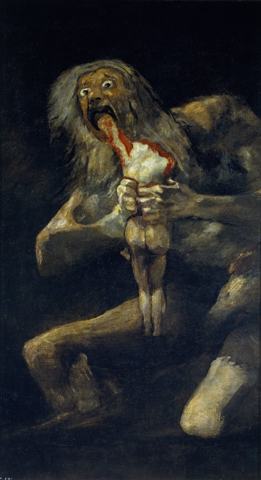
Rome's god of sowing and the lost Golden Age, whose temple held the state treasury and whose December festival turned the social order upside down.
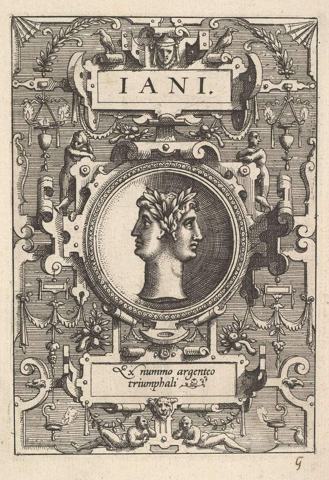
The two-faced Roman god of doors, beginnings and endings, named first in every prayer, whose gates in the Forum stood open only while Rome was at war.
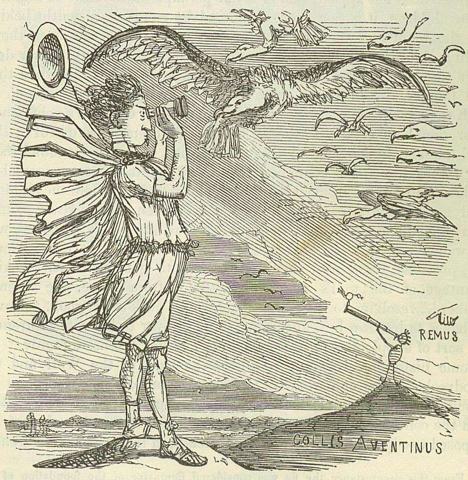
How Roman magistrates read the will of the gods from bird-flight and lightning before every public act — the state's oldest form of applied religion.
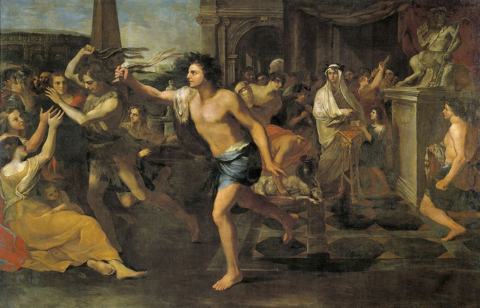
Rome's February fertility rite at the wolf's cave, where near-naked priests struck bystanders with goat-hide thongs — its link to Valentine's Day is unproven.
Ovid's 15-book Latin epic of transformation myths — the single work that shaped how the post-classical West came to know Greek and Roman mythology.
King of the gods and of the Roman state — lord of the bright sky, hurler of the lightning bolt, and the guarantor behind every oath and treaty.
Sources & Further Reading
- 1.Macrobius, Saturnalia — Book I (early 5th century AD).
- 2.Statius, Silvae — I.6, "Kalendae Decembres" (c. AD 90s).
- 3.Martial, Epigrams — Book XIV, the Apophoreta (c. AD 84-85).
- 4.Lucian, Saturnalia (2nd century AD).
- 5.Pliny the Younger, Epistulae — Book II.17 (c. AD 100).
- 6.Versnel, H.S. Inconsistencies in Greek and Roman Religion II — Transition and Reversal in Myth and Ritual. Brill, 1993.
- 7.Beard, Mary, John North and Simon Price. Religions of Rome. 2 vols. Cambridge University Press, 1998.
- 8.Hijmans, Steven E. "Sol Invictus, the Winter Solstice, and the Origins of Christmas." Mouseion, series III, vol. 3, no. 3, 2003.
Spot an error or have a source to suggest? Write to info@viseterna.com. We cite primary sources and modern scholarship, and we correct fast.