
Saturn
Rome's god of sowing and the lost Golden Age, whose temple held the state treasury and whose December festival turned the social order upside down.
Saturn Devouring His Son (from the Black Paintings), Francisco de Goya, 1819-1823 (Museo del Prado, Madrid) · Public domain · source
Who Saturn Was
Saturn (Latin Saturnus) was one of the oldest gods of the Roman state calendar, and one of the hardest to pin down. Roman antiquarians connected his name to serere / satus, "to sow", and treated him as the god who taught men to plant and prune; his emblem is the falx, the curved pruning-hook or sickle 4,2. Modern philologists are less confident: the derivation from serere is phonologically awkward, and many scholars now suspect an Etruscan divine name, Satre, standing behind the Latin one. Either way his festival, his temple and his priesthood are attested from the earliest layers of Roman religion we can reach 5,6.
His consort was Ops, goddess of plenty and abundance, whose own festival fell in the same December cluster — a pairing that reads as sowing and its yield 1,2.
The Golden Age in Latium
Roman poets built Saturn a mythical biography by folding him together with the Greek Kronos: the sky-father's son who overthrew his father, swallowed his own children, and was in turn deposed by Jupiter 2. To that inherited Greek story the Romans added something of their own. Driven out of heaven, Saturn came to Italy, was received by Janus, and ruled the land that took its name, some said, from his latere — his hiding 2,4.
Virgil gives the fullest version. Evander tells Aeneas that Saturn gathered a scattered and lawless people, gave them laws, and that under him came the age men called golden: no walls, no war, no ownership, the earth yielding freely 3. That backwards-looking utopia mattered practically, because it is the charter for what the Romans actually did in December. Scholars have long argued that the Saturnalia was understood as a brief, licensed replay of the Golden Age rather than a mere harvest holiday 7,5.
The Temple and the Treasury
Saturn's temple stood at the western foot of the Capitoline, at the head of the Forum, on ground Roman tradition already regarded as ancient. Its dedication was placed by the annalists in the first years of the Republic, around 497 BC 5. Eight columns of a late rebuild still stand today, carrying an inscription recording that the Senate and People of Rome restored what fire had consumed.
The building's civil function outweighed its ritual one. It housed the aerarium Saturni, the treasury of the Roman state — the bullion reserve, the bronze tablets of laws, and the standards of legions not in the field 5,6. Why the treasury sat with Saturn is not securely explained; ancient writers offered the tidy answer that the Golden Age had no theft 2.
Sacrifice at Saturn's altar was performed Graeco ritu, in the "Greek manner", with the officiant's head uncovered rather than veiled as in ordinary Roman practice — one of the details that led ancient writers to treat him as an imported god, though the argument runs both ways 2,6. Macrobius also reports the striking custom that the god's cult statue stood through the year with its feet bound in woollen fetters, loosed only for the festival 2.
The Saturnalia
The Saturnalia opened on 17 December with a public sacrifice at the temple and a banquet, and spilled outward into the most famous holiday in the Roman year. Its length crept from one day to three, then five, then seven; Augustus and later Caligula both legislated on the question, and the sprawl never quite stopped 2,5.
Its signature was inversion. Courts and schools closed, formal togas were set aside for loose dinner clothes, gambling was tolerated, and the pilleus — the felt cap of the freedman — was worn by everyone. Households reversed roles: masters served their slaves at table, or dined first and then handed over the room, and slaves were licensed to speak with a freedom that would otherwise have been punished 2,7. A "king" of the revels, chosen by lot, issued absurd commands. Gifts passed between friends and dependants, chiefly wax candles (cerei) and small clay figurines (sigillaria), and the greeting io Saturnalia rang through the streets 1,2.
Scholars debate how far this licence subverted the Roman order and how far it reinforced it. Versnel and others read the festival as a controlled reversal that made the ordinary hierarchy visible precisely by suspending it for a week 7; the plainer reading, that a slave society needed an annual valve, is not incompatible with it.
Afterlife of the Name
Saturn kept a life outside the temple. His name attached to the outermost planet then known and to the seventh day of the planetary week, which is why English still has Saturday — the only day in English retaining a Roman god where the others were re-cut with Germanic ones 5. Later antiquity, and the astrology it absorbed, made Saturn cold, slow, old and heavy: the melancholic planet, the aged devourer with the scythe.
That last figure — Time as an old man with a sickle, eating his children — is a medieval and Renaissance fusion of Saturn with Greek Kronos and Greek chronos, "time" 2. It is the image Goya painted, and it has almost nothing to do with the Italian god of sowing whose festival was the happiest week of the Roman year. Both are Saturn; they simply arrived by different roads.
Continue Exploring

The two-faced Roman god of doors, beginnings and endings, named first in every prayer, whose gates in the Forum stood open only while Rome was at war.
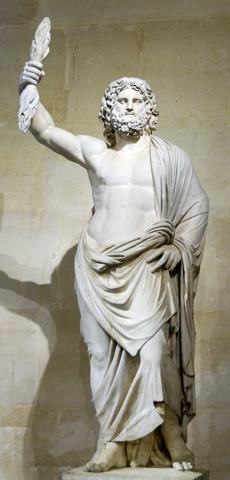
King of the gods and of the Roman state — lord of the bright sky, hurler of the lightning bolt, and the guarantor behind every oath and treaty.
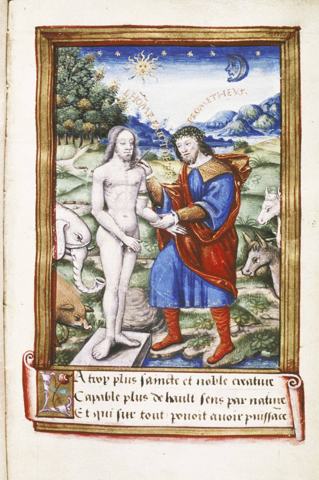
Ovid's 15-book Latin epic of transformation myths — the single work that shaped how the post-classical West came to know Greek and Roman mythology.
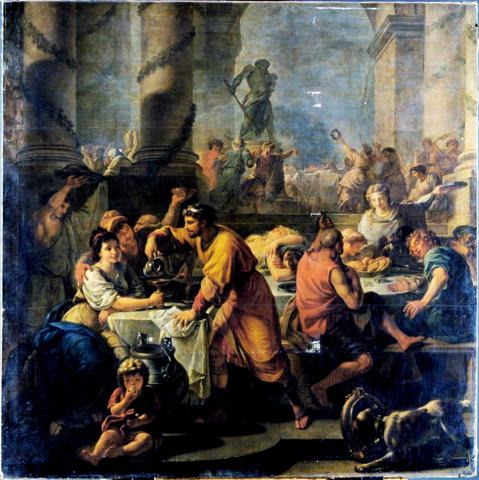
Rome's December festival of role reversal and gifts, when slaves dined with masters and the freedman's cap was worn by all — likely not the root of Christmas.
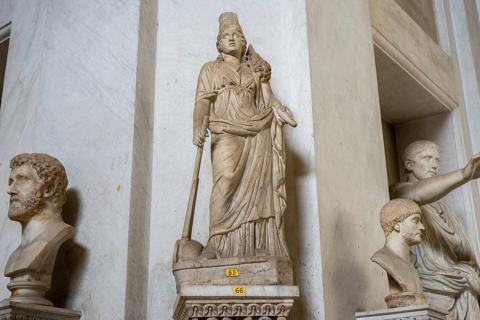
Rome's goddess of luck, worshipped under dozens of specific titles and consulted through a wooden-lot oracle at Praeneste that Cicero called a fraud.
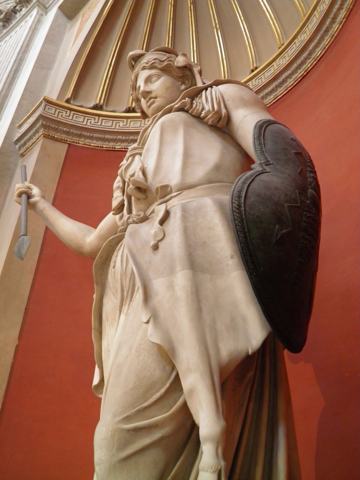
Queen of the gods — Rome's guardian of women, childbirth and the state, whose sacred geese warned the Capitol and whose temple gave us the word money.
Sources & Further Reading
- 1.Ovid, Fasti — Books I and VI (c. AD 8).
- 2.Macrobius, Saturnalia — Book I (early 5th century AD).
- 3.Virgil, Aeneid — Book VIII, lines 314-358 (Evander on Saturn in Latium, c. 19 BC).
- 4.Varro, De Lingua Latina — Book V (c. 45 BC).
- 5.Beard, Mary, John North and Simon Price. Religions of Rome. 2 vols. Cambridge University Press, 1998.
- 6.Scheid, John. An Introduction to Roman Religion. Trans. Janet Lloyd. Indiana University Press, 2003.
- 7.Versnel, H.S. Inconsistencies in Greek and Roman Religion II — Transition and Reversal in Myth and Ritual. Brill, 1993.
Spot an error or have a source to suggest? Write to info@viseterna.com. We cite primary sources and modern scholarship, and we correct fast.