
Fujin (Japanese Wind God)
Japan's wind kami — a demon-bodied figure who races across temple screens with a bag of winds over his shoulders, paired with but distinct from Raijin.
Wind God (right screen of Wind God and Thunder God), Ogata Korin, after Tawaraya Sotatsu, 17th–18th century · Public domain · source
Two Chronicles, Two Births
Japan's wind god goes by Fujin (風神) in general usage today, but the eighth-century chronicles know him by an older name, Shinatsuhiko, sometimes paired with a female form, Shinatobe. The Kojiki places him among the many nature kami that Izanagi and Izanami bear after the islands themselves, one entry in a long genealogical list with no story attached 1. The Nihon Shoki gives him a more vivid entrance: after the great islands are formed, Izanagi finds them still wrapped in morning mist and blows it away, and the god of wind, Shinatsuhiko, is born from that breath 2. Shina is glossed as "long breath," and the Nihon Shoki's account makes wind, quite literally, the exhalation of a god 2.
Neither text gives Shinatsuhiko a body, a temperament, or a myth of his own. The muscular, fanged, wind-bag-carrying figure everyone now pictures as Fujin comes from somewhere else entirely, and considerably later 4,5.
A Body Borrowed Along the Silk Road
Fujin's iconography has a documented, and surprising, travel history. Tanabe's catalogue for a major 2003 exhibition on Hellenistic contact with East Asia traces the wind-bag motif back to the Greek wind god Boreas, shown in Hellenistic art billowing a cloak or sack over his shoulders; that image travelled east with Greco-Buddhist art into Bactria as the deity Wardo, then into China as the wind god Feng Bo, and finally into Japan as Fujin, the bag reinterpreted along the way as a sack of captured winds 3. The same transmission route carried the demon-guardian body type — bulging muscles, bared fangs, animal-skin loincloth — that both Fujin and Raijin wear in Buddhist temple sculpture, a visual language shared with other wrathful guardian figures imported from India through China 4,5.
By the time this iconography reached Japan, Buddhist cosmology had its own wind deity to graft it onto: Vayu, absorbed into the esoteric pantheon as one of the Twelve Devas (Junten) under the name Futen 3. Fujin, the demon-bodied runner with the wind-bag, and Futen, the Buddhist deva, were never fully separated in Japanese religious art, and Reider notes this kind of layering — native kami, Buddhist deva, and folk demon collapsing into one figure — as entirely typical of how Japan absorbed imported iconography rather than replacing what was already there 5.
Paired With, and Distinct From, Raijin
Fujin's single most famous appearance is alongside the thunder god on Tawaraya Sotatsu's seventeenth-century folding screens, Fujin Raijin-zu, copied afterward by Rinpa painters including Ogata Korin — the version reproduced here 4. The two gods also stand together among the twenty-eight attendants of Kannon at Sanjusangen-do in Kyoto, guardian statues from the Kamakura period that give each god a distinct implement: Raijin his ring of drums, Fujin his great sack, held open in both hands as though he is about to release or has just caught a gale 4,5.
It is worth separating what belongs to each god specifically. Raijin's drums, oni-red skin, and folklore about stealing children's navels are his own; Fujin's identity is built entirely around the bag, the one prop no artist omits, because it is the only visual cue that distinguishes "wind" from every other muscular green or red demon in the Buddhist guardian repertoire 4,5.
Wind as Weather, Wind as Providence
Ordinary wind belief was more sober than the temple imagery suggests. Shrine registers preserve Kaze-no-Miya, wind shrines dedicated to Shinatsuhiko and Shinatobe as subsidiary sanctuaries of Ise, where prayers for good wind and against storm damage to the rice crop were a standing part of shrine business 2,6. Hardacre notes that Ise's wind shrines gained new prominence after the failed Mongol invasions of the late thirteenth century, when storms that scattered the Yuan fleets were read at court as divine intervention — the origin of the later term kamikaze, "divine wind" — and the shrines' rank was raised accordingly 6. That episode ties Japan's oldest wind kami to one of its most consequential pieces of national memory, centuries before the demon-bodied Fujin of temple art had fully taken shape 6.
Fujin Today
The bag-carrying wind god remains one of the most recognisable figures in Japanese religious art, reproduced on temple gates, folding screens, and festival floats wherever he appears with his thunder-god partner 4. Unlike Raijin, Fujin has no rich folklore of captured spirits or navel-stealing mischief attached to him in the Edo-period record; he stays what the Silk Road handed Japan and what the chronicles first breathed into being — weather with a face, defined by nothing but the wind he carries and releases 2,3,5.
Continue Exploring
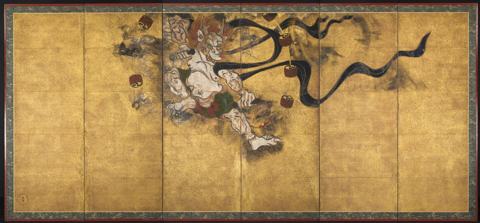
The thunder kami who drums the storm into being — oni-faced, ringed with taiko, and paired in Japanese art with the wind god Fujin.
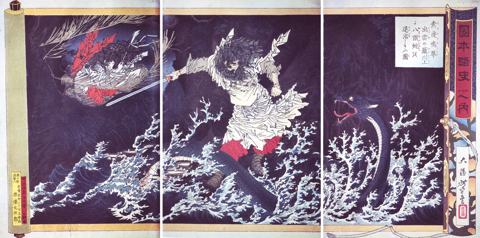
The raging kami of sea and storm — expelled from heaven for wrecking his sister's fields, then redeemed in Izumo by slaying an eight-headed serpent.
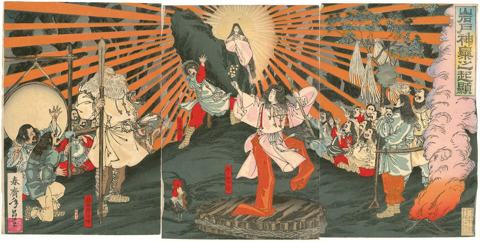
The sun goddess who shines in heaven — ruler of the Plain of High Heaven, ancestor of Japan's imperial line, and the kami enshrined at Ise.
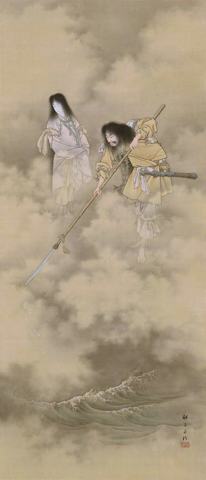
The creator pair of Japanese myth: they stirred the first island out of the sea, bore the land itself, and were parted forever by death.
The moon kami born from Izanagi's right eye — ruler of the night, whose single recorded act of violence set the sun and moon forever apart.
The Izumo kami who healed a skinned hare, survived his own brothers twice, built the land with a tiny god, and ceded it all to Amaterasu's line.
Sources & Further Reading
- 1.Kojiki (Records of Ancient Matters, 712) — Book One; trans. Donald L. Philippi, University of Tokyo Press, 1968.
- 2.Nihon Shoki (Chronicles of Japan, 720) — Book One, in W.G. Aston (trans.), Nihongi. Kegan Paul, 1896.
- 3.Tanabe, Katsumi, ed. Alexander the Great — East-West Cultural Contacts from Greece to Japan. Tokyo National Museum, 2003.
- 4.Foster, Michael Dylan. The Book of Yokai: Mysterious Creatures of Japanese Folklore. University of California Press, 2015.
- 5.Reider, Noriko T. Japanese Demon Lore: Oni from Ancient Times to the Present. Utah State University Press, 2010.
- 6.Hardacre, Helen. Shinto: A History. Oxford University Press, 2017.
Spot an error or have a source to suggest? Write to info@viseterna.com. We cite primary sources and modern scholarship, and we correct fast.