
Mid-Autumn Festival (Zhongqiu Jie)
China's harvest-moon festival of family reunion, mooncakes, and lantern-lit nights under the fullest moon — inseparable from the goddess Chang'e.
Chang'e Flees to the Moon, Tsukioka Yoshitoshi, from One Hundred Aspects of the Moon, c. 1885-1892 (a Japanese print of the Chinese moon-goddess legend) · Public domain · source
The Fifteenth of the Eighth Month
Zhongqiu Jie, the Mid-Autumn Festival, falls on the fifteenth day of the eighth lunar month, when the harvest moon is traditionally at its fullest and roundest of the year — the name simply means "mid-autumn," marking the season's midpoint rather than any single event 4,5. It is a public holiday in China and Taiwan, is widely observed across Chinese communities in Southeast Asia and the diaspora, and has close but distinct counterparts elsewhere in the region, including Vietnam's Tet Trung Thu, which shares its date and much of its imagery without being simply an export of the Chinese festival 4.
An Ancient Sacrifice to the Moon
The festival's deepest root is a state ritual rather than a folk one. Bodde's study of Han-dynasty ceremonial calendar records seasonal court sacrifices bracketing the year — offerings tied to the sun's and the moon's movements among them — performed by the ruler on behalf of the whole realm, a formal cosmological observance with little of the domestic warmth the modern festival is known for 3. That old state astronomy supplied the date and the underlying idea that the autumn moon deserved ritual attention, but the family festival recognizable today is a considerably later, and much more popular, development layered on top of it 3,4.
The Tang and Song Festival
Moon-viewing as a literary and social pleasure flourished among Tang-dynasty poets and courtiers, who gathered to drink and write verse under the autumn moon without yet marking a single fixed festival day for it 2,4. Eberhard's survey of the Chinese festival calendar places this Tang literary fashion as the direct forerunner of the fixed folk holiday, tracing how an elite pastime with no set date hardened, over the following centuries, into the popular fifteenth-of-the-eighth-month festival 2. By the Northern Song, the occasion had become a fixed, citywide event. Meng Yuanlao's Dongjing Meng Hua Lu, a memoir of life in the Song capital of Kaifeng, describes Mid-Autumn night there in concrete detail: markets staying open and thronged after dark, wine shops redecorated and fully booked, and households of every means — from the wealthy on their private terraces to ordinary city-dwellers in shared courtyards — staying up together to look at the moon 1. That account is the clearest surviving evidence that Zhongqiu Jie had become, by the twelfth century, the broad-based reunion festival it still is 1.
Mooncakes, the Rabbit, and the Cassia Tree
The festival's food is the round mooncake, a dense pastry usually filled with lotus-seed or red-bean paste and often a salted egg yolk at its center to stand for the moon itself, its shape standing for both the full moon and the wholeness of a reunited family 4. The associated mythology is Chang'e's: the goddess who fled to the moon with the elixir of immortality, the jade rabbit who pounds more of it in a mortar at her side, and Wu Gang, condemned to cut forever at a self-healing cassia tree that also grows there — the full cast is Chang'e's own story, and the festival is essentially her feast day 4,5. A popular modern legend also holds that fourteenth-century rebels hid messages calling for uprising against Mongol rule inside mooncakes distributed at this festival; it is a vivid story, repeated constantly around the holiday, but it appears in no source earlier than much later retellings, and should be treated as festival folklore about the festival rather than as verified history 4.
Lanterns and a Living Festival
Lantern displays, more central to the separate Lantern Festival that closes the New Year season two months earlier, also appear at Mid-Autumn in parts of southern China and Hong Kong, most spectacularly in the Tai Hang district's fire dragon dance, in which a dragon built from straw and thousands of burning incense sticks is carried through the streets over three nights — a tradition local records trace to 1880, when it was performed to end a plague, and one still repeated every Mid-Autumn since 4. Across the wider festival, the core practice has stayed remarkably constant since Meng Yuanlao's account: family members travel to be together, share mooncakes and fruit, and sit outside after dark for no more complicated reason than to look at the moon together 1,4.
A Festival Between Two Others
Zhongqiu Jie sits at the calm midpoint of the same yearly cycle that opens with the noise and red paper of Nian in winter and races dragon boats at the Dragon Boat Festival in early summer 4. Where those two festivals are loud, apotropaic, and outward-facing, Mid-Autumn is quiet and domestic by comparison — the one major date in the traditional calendar built not around driving something away, but simply around bringing a family back into the same room 1,3,4.
Continue Exploring
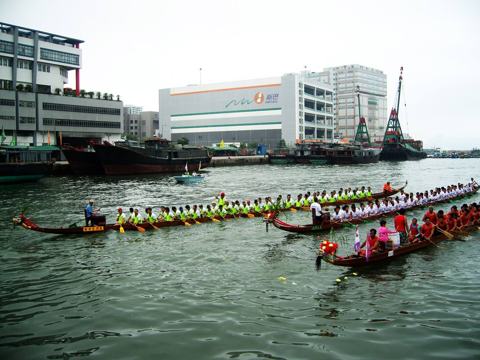
China's fifth-month river festival of racing dragon boats and rice dumplings — tied to the poet Qu Yuan's drowning, though the boats likely predate him.
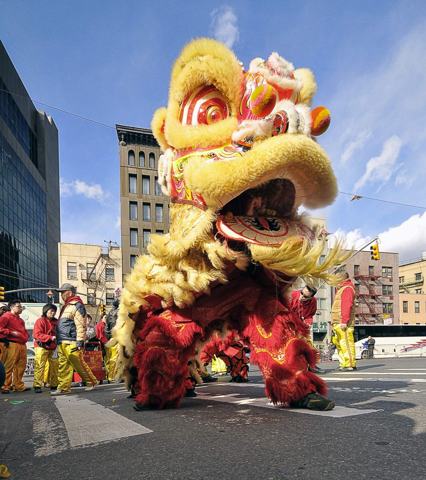
The horned beast said to terrorize villages once a year until scared off by firecrackers, fire, and red — a legend newer than the New Year customs it explains.
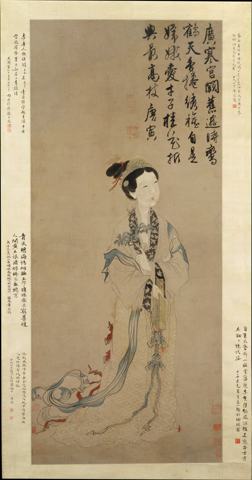
The moon goddess who swallowed the elixir of immortality and rose beyond reach — honoured each Mid-Autumn Festival with mooncakes and lanterns.
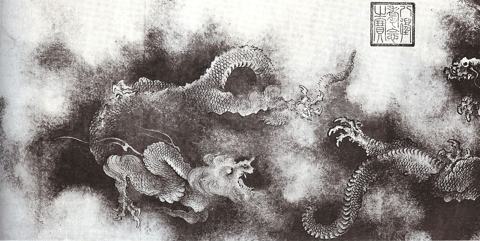
China's dragon — a benevolent, scaled power of rain, river, and sea, emblem of imperial authority and the only mythical beast in the zodiac.
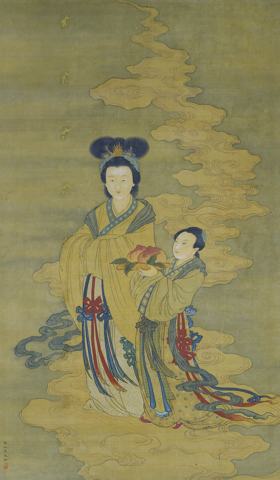
A tiger-toothed mountain spirit who became China's greatest goddess of immortality, keeper of the peaches that ripen once in three thousand years.
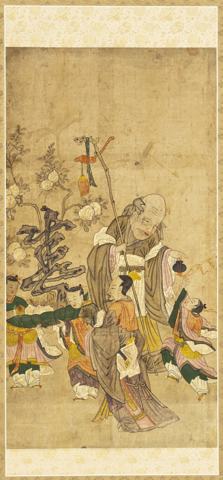
The fruit that ripens once every three thousand years in the Queen Mother's orchard — eaten by the wrong guest, it triggered heaven's most famous brawl.
Sources & Further Reading
- 1.Meng Yuanlao, Dongjing Meng Hua Lu — The Eastern Capital: A Dream of Splendor (c. 1147 CE).
- 2.Eberhard, Wolfram. Chinese Festivals. Henry Schuman, 1952.
- 3.Bodde, Derk. Festivals in Classical China: New Year and Other Annual Observances During the Han Dynasty, 206 B.C.-A.D. 220. Princeton University Press, 1975.
- 4.Yang, Lihui & Deming An. Handbook of Chinese Mythology. ABC-CLIO, 2005.
- 5.Birrell, Anne. Chinese Mythology: An Introduction. Johns Hopkins University Press, 1993.
Spot an error or have a source to suggest? Write to info@viseterna.com. We cite primary sources and modern scholarship, and we correct fast.