
Amun (Amun-Ra)
The imperial god of the New Kingdom — a once-minor Theban god whose name means "hidden," fused with Ra until Akhenaten tried to erase him from Egypt.
Statuette of Amun-Re, Egyptian bronze (Walters Art Museum) · Public domain · source
A Name That Means Absence
Amun — Egyptian Imn, also rendered Amon or Amen — means "the hidden one," and Egyptian theologians treated the name as a genuine description rather than a poetic flourish 5,6. Unlike the sun disk, the flooding Nile, or the jackal at the cemetery edge, nothing in visible nature stood for him; he was air and breath, present in every lungful and invisible in every one 5. The New Kingdom hymns collected in Papyrus Leiden I 350 make this the centre of his theology outright, praising him as a god "more hidden than the gods," whose true form and true name are unknown even to the rest of the pantheon, and who nonetheless "came into being at the first," before any of the other creator gods claimed that honour for themselves 2. Concealment, in other words, was not a limitation on Amun's power. It was the source of it.
A Minor God's Rise
Amun is not one of Egypt's oldest deities in the way Ra or Ptah are. He appears already in the Pyramid Texts of the Old Kingdom, but only as a minor figure paired with a female counterpart, Amaunet, among the eight primordial forces of the Hermopolitan cosmology, gods representing formless qualities like darkness and infinity before creation 1,5. His transformation began locally, at Thebes, then a provincial town of no particular importance, where he became the city's patron. Thebes's own fortunes changed that story. When Theban princes reunified Egypt at the start of the Middle Kingdom, and again after driving out the Hyksos at the start of the New Kingdom, Amun rose with his city, from a local god to the god credited with the ruling dynasty's victories 5,6.
Amun-Ra and the Theology of Combination
Egyptian religion routinely let gods merge without either one disappearing, and Amun's defining fusion was with Ra himself, producing Amun-Ra, the composite who became, in effect, the state god of the New Kingdom empire 5,6. The combination let theologians have it both ways: Ra supplied the visible, daily, undeniable proof of divine power in the disk crossing the sky, while Amun supplied the transcendent, ungraspable depth behind that visible disk — a sun god who was also, simultaneously, the hidden totality the sun could only partly reveal 4. The Leiden hymns push this synthesis into something close to a claim of underlying unity behind Egypt's whole crowded pantheon, describing other gods as manifestations sheltering within Amun's hidden nature, a line of thought Jan Assmann has argued moved New Kingdom theology to the edge of the ideas Akhenaten would shortly try to force into a single god by decree 4.
Karnak, Thebes, and the Machinery of Empire
Amun's temple at Karnak, expanded by nearly every New Kingdom pharaoh in turn, became the largest religious complex Egypt ever built, its avenues, pylons and hypostyle hall standing today as the clearest physical measure of how completely his cult had absorbed the wealth of empire 5,6. The annual Opet Festival carried his cult image in procession from Karnak to the Luxor temple to renew the king's divine authority, while the Beautiful Festival of the Valley sent it across the river to the necropolis, binding Amun's cult directly to royal legitimacy on one bank and to the cult of the royal dead on the other 5,6. His priesthood grew to match: by the later New Kingdom the High Priests of Amun controlled land, labour and temple wealth on a scale that rivalled the crown itself, a concentration of institutional power that had no real precedent in earlier Egyptian religion 5. Karnak's daily liturgy also enacted the two obligations every major Egyptian temple owed the cosmos: priests repelled the serpent Apophis in Amun-Ra's name each morning so the sun could keep moving, and the king's own presentation of a small image of Maat before the god's shrine renewed the claim that his throne still kept the world in order 5,6.
The Amarna Interruption
That concentration of wealth and theological prestige is very likely what made Amun the specific target when Akhenaten came to the throne and elevated the sun disk Aten above every other god. Redford's study of the reign describes a campaign that went well beyond simple neglect: royal workmen were sent out to physically chisel Amun's name and image out of temple walls, tombs, and even the cartouches of earlier kings, wherever they could be reached, in a deliberate act of erasure rather than mere disfavour 3. Amun's great temples were closed and their revenues redirected, and for roughly a generation the god whose name meant "hidden" was hidden by decree rather than by nature 3,4.
Restoration and Long Afterlife
The eclipse did not last. Akhenaten's successors, beginning with the boy king originally named Tutankhaten, restored the old cults and changed their own names to advertise it — Tutankhaten became Tutankhamun, "living image of Amun," and his restoration stela records the old temples reopened and the old priesthoods reinstated 5,6. Amun-Ra went on to become the god the Greeks identified with Zeus as Zeus Ammon, with an oracle at the Siwa Oasis famous enough that Alexander the Great crossed the desert to consult it, a piece of afterlife that carried Amun's name, if not his hidden theology, far outside Egypt itself 5,6.
Continue Exploring
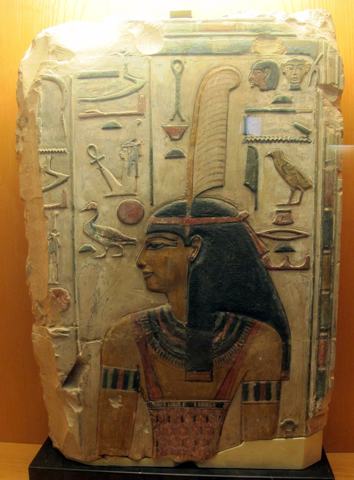
Truth and cosmic order personified — the goddess whose feather weighed every dead Egyptian's heart, and the standard every king swore to uphold.
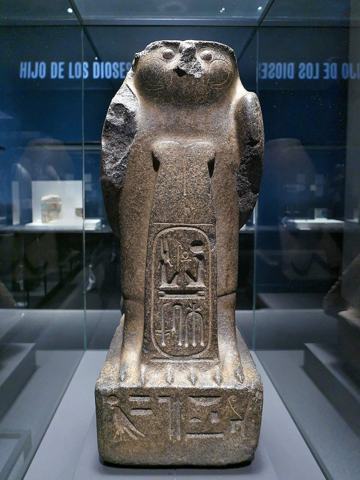
The sun itself as a god — Ra sails the sky by day, fights the serpent of chaos by night, and is reborn on the horizon every dawn.
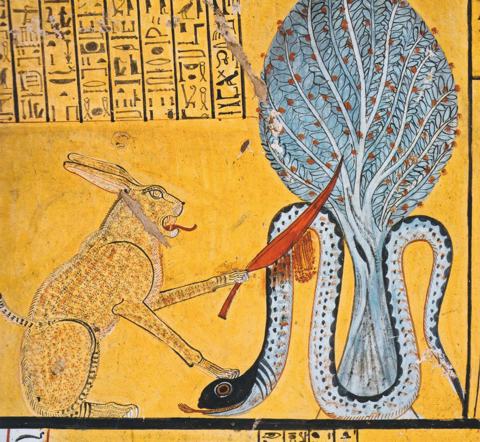
The great serpent who attacks the sun boat every night — Apophis is Egypt's embodiment of chaos, repelled again each dawn but never finally destroyed.
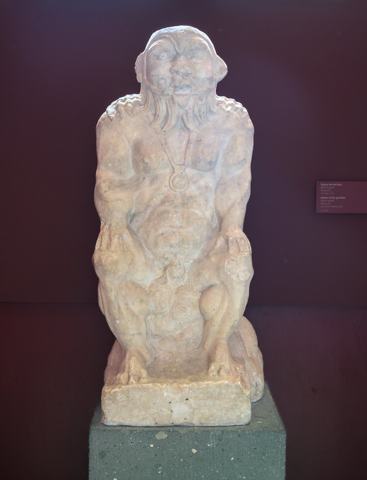
The grinning dwarf god who guarded bedrooms rather than temples — a fierce, funny protector of mothers and infants, armed with noise and a terrifying face.
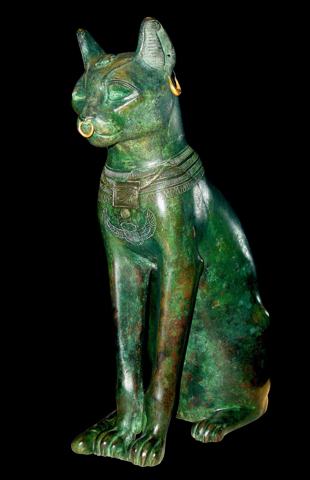
Egypt's cat goddess — a lioness of the Eye of Ra who softened into the guardian of the home, honoured at Bubastis with the loudest festival in Egypt.
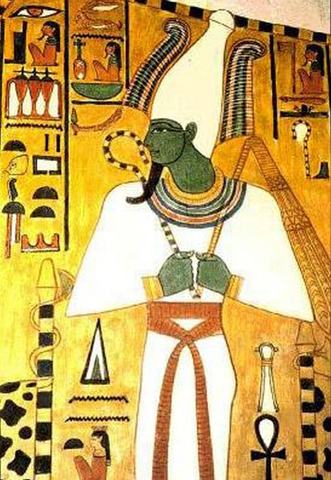
Lord of the afterlife — the murdered king remade as the first mummy, whose resurrection promised every Egyptian a life beyond the grave.
Sources & Further Reading
- 1.Pyramid Texts (Old Kingdom, c. 2400-2300 BCE).
- 2.Papyrus Leiden I 350, Hymns to Amun (19th Dynasty, reign of Ramesses II).
- 3.Redford, Donald B. Akhenaten: The Heretic King. Princeton University Press, 1984.
- 4.Assmann, Jan. Egyptian Solar Religion in the New Kingdom: Re, Amun, and the Crisis of Polytheism. Translated by Anthony Alcock. Kegan Paul International, 1995.
- 5.Wilkinson, Richard H. The Complete Gods and Goddesses of Ancient Egypt. Thames & Hudson, 2003.
- 6.Pinch, Geraldine. Egyptian Mythology: A Guide to the Gods, Goddesses, and Traditions of Ancient Egypt. Oxford University Press, 2002.
Spot an error or have a source to suggest? Write to info@viseterna.com. We cite primary sources and modern scholarship, and we correct fast.