
Bacchus (Liber)
Rome's own wine and fertility god Liber, so thoroughly merged with Greek Bacchus that the Senate outlawed his mystery cult across Italy in 186 BC.
Bacchus, Caravaggio, c. 1598 (Galleria degli Uffizi) · Public domain · source
Liber Pater, an Old God of the Free
Long before "Bacchus" meant anything to a Roman audience, Liber Pater — "the Free Father" — was already an old Italian god of the vine, of male fertility, and, as his name suggests, of the free condition of citizenship itself 7. He was worshipped in a state cult on the Aventine alongside Ceres and Libera, a triad the Romans themselves read as parallel to Demeter, Dionysus and Kore, even though Liber's own cult predated any close identification with the Greek wine god 3,7. The overlap was real, though: Roman writers used "Liber" and "Bacchus" almost interchangeably by the late Republic, and this article follows that convention while keeping the older, native name in view 7.
The Liberalia and a Coming-of-Age Rite
Liber's central Roman festival, the Liberalia, fell on 17 March, and Ovid describes it as the day Roman boys traditionally exchanged the purple-bordered toga of childhood for the plain white toga of manhood — a rite of passage that had nothing obviously to do with wine 3. In the countryside the same festival kept an older, cruder character: old women called sacerdotes Liberi sold honey cakes at roadside altars, and Augustine, writing centuries later as a hostile Christian critic, describes processions at Lavinium in which an oversized phallic image, Liber's ancient fertility symbol, was carried through the fields on a cart and then crowned in public by a respectable married woman — a rite he treats as proof of Roman religion's indecency but which scholars now read as a startlingly well-preserved fragment of very old Italian fertility ritual, of a kind not unlike the rustic worship still attached to gods such as Faunus 4,7.
An Ecstatic Cult Spreads North
Separately from Liber's civic cult, an initiatory mystery religion centered on the Greek Dionysus/Bacchus spread into Italy from Greek southern Italy and Etruria over the third century BCE, organized in private cells or thiasoi rather than around a single state temple, open to women as well as men, and built on secret rites of initiation rather than public festival days 1,6. Erich Gruen argues that Rome had no consistent policy against foreign cults as such — plenty of Greek gods entered the city without incident — so whatever provoked the crisis of 186 BCE has to be found in this cult's particular structure of secrecy and its independence from ordinary civic and family authority, not in its foreignness alone 6.
Panic in the Senate: 186 BCE
Livy's account, written a century and a half later but drawing on the Senate's own records, describes how the affair became public: a freedwoman named Hispala Faecenia, alarmed that her young lover was about to be initiated, revealed the cult's inner workings to the consul Postumius, describing nighttime ceremonies, oaths of silence, and — in Livy's telling — crimes ranging from sexual assault to murder, organized under a priestess named Paculla Annia who had reportedly restructured the rites to admit men and hold meetings five times a month instead of three times a year 1,5. Sarolta Takács has argued that what alarmed the Senate was less any specific crime than the cult's inversion of Roman authority: young men were being initiated by women and by leaders outside the household, a direct challenge to a paterfamilias's control over his own sons in a state built on that control 5.
The Bronze Decree
The Senate's response survives twice over: in Livy's narrative and, independently, on a bronze tablet discovered in 1640 at Tiriolo in Calabria, inscribed with the text of the senatus consultum de Bacchanalibus 1,2. The decree did not ban Bacchic worship outright — it permitted small gatherings under strict conditions, capped at two men and three women, requiring Senate approval in advance for anything larger — but it dismantled the cult's independent organization: no shared funds, no oaths, no priests without individual senatorial permission, enforced across all of Italy, not just the city of Rome 2,6. Modern historians read the surviving inscription as the earliest inscribed evidence of the Roman state legislating religious practice on this scale, and both Gruen and Takács treat it as a political document responding to a perceived threat to the social order more than a straightforward religious persecution 2,5,6.
Bacchus After the Ban
Bacchic worship did not disappear — the decree itself assumes it will continue under supervision — and by the Empire, Bacchus/Liber had settled into the more familiar literary and artistic figure of Roman culture: a wine god trailed by satyrs and maenads, celebrated by Ovid and Horace, and a common subject on sarcophagi, where his promise of a joyful afterlife made him an increasingly popular alternative to the state's more austere official religion, in much the way the later mystery cult of Mithras would offer initiates their own private promise of salvation 3,7. The old civic Liber, free father of the Aventine triad and patron of a boy's coming of age, and the ecstatic Bacchus of the mysteries never fully separated again in the Roman imagination, even after the Senate had tried, briefly and forcefully, to keep them apart 6,7.
Continue Exploring
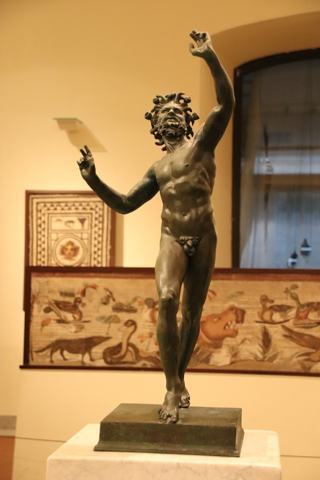
Rome's rustic god of forest and flock, an oracle who spoke through dreams and whose name the Romans linked to the Lupercalia and to Greek Pan and the satyrs.
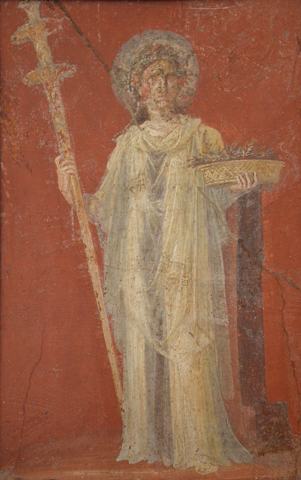
Rome's grain goddess, patron of the plebeian order, whose search for her stolen daughter gave the city its most solemn public festival.
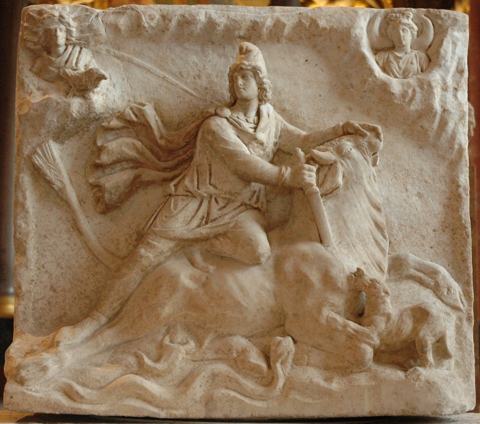
The bull-slaying god of a Roman mystery cult that left hundreds of underground temples across the empire and not one line of its own scripture.
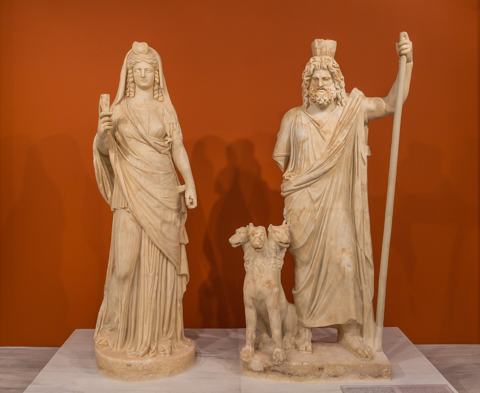
Lord of the underworld — the Roman god of the dead whose older name, Dis Pater, means "the rich father": wealth is what lies buried in the ground.
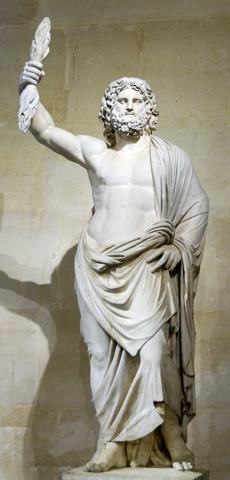
King of the gods and of the Roman state — lord of the bright sky, hurler of the lightning bolt, and the guarantor behind every oath and treaty.
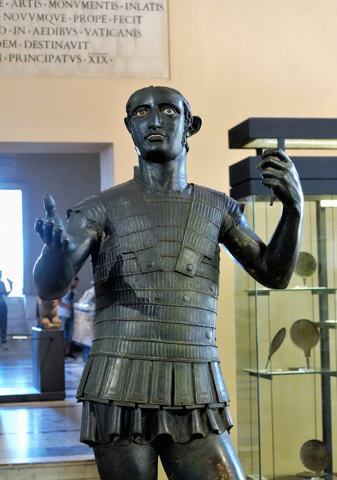
God of war and father of Rome — honoured above almost every other deity, with his own month, his own dancing priests, and the twins he fathered on a Vestal.
Sources & Further Reading
- 1.Livy, Ab Urbe Condita — Book XXXIX.8-19 (the Bacchanalian affair, 186 BCE).
- 2.Senatus consultum de Bacchanalibus (186 BCE), bronze inscription, CIL I(2) 581.
- 3.Ovid, Fasti — Book III (the Liberalia, c. AD 8).
- 4.Augustine, City of God — Book VII.21 (early 5th century AD, describing older Italian ritual).
- 5.Takács, Sarolta A. "Politics and Religion in the Bacchanalian Affair of 186 B.C.E." Harvard Studies in Classical Philology, vol. 100, 2000, pp. 301-310.
- 6.Gruen, Erich S. Studies in Greek Culture and Roman Policy. University of California Press, 1990.
- 7.Beard, Mary, John North & Simon Price. Religions of Rome, Volume 1: A History. Cambridge University Press, 1998.
Spot an error or have a source to suggest? Write to info@viseterna.com. We cite primary sources and modern scholarship, and we correct fast.