
The Mabinogion
Eleven medieval Welsh tales — Four Branches, native stories, Arthurian romances — bundled under a title that scholars agree is a 19th-century mistake.
White Book of Rhydderch (Llyfr Gwyn Rhydderch), folio 45r, c. 1350 (National Library of Wales, Peniarth MS 4) · CC0 · source
Eleven Tales, One Misnomer
"The Mabinogion" names a collection, not a single work: eleven independent medieval Welsh prose tales, unconnected by any single narrator or frame, that modern publishing has bound together under one cover since the nineteenth century 3,4. The title itself is a documented error. The Welsh word mabinogi — of disputed meaning, probably connected to mab, "boy" or "son," and glossed as something like "a tale of youth" — appears correctly at the close of four of the tales. A single manuscript ends one of those four with the corrupted plural mabynnogyon, almost certainly a scribe's slip rather than a real word, and it was this one mistake that the tales' first English translator generalised into a title for the whole set 7,8. Scholars have known this for well over a century; the name has stuck anyway, which is itself a small lesson in how translation can outlive its own footnotes 7.
The Manuscripts
No version of any tale survives from before the fourteenth century. The fullest early witness is the White Book of Rhydderch, copied around 1350 and now held at the National Library of Wales, followed some decades later by the Red Book of Hergest, a much larger vellum compilation of Welsh prose and poetry written between about 1382 and 1410 and now at the Bodleian Library 1,2. The two overlap closely enough in wording that they are usually treated as independent copies of a shared, now-lost exemplar rather than one copying the other directly, and between them they preserve all eleven tales, though not always complete in either book alone 1,2,6.
What's Inside
The core is the Four Branches of the Mabinogi proper — Pwyll, Branwen, Manawydan, and Math — a connected cycle whose branches share recurring characters (Pryderi above all) without forming a single continuous plot 6. Rhiannon and Bran the Blessed belong to this core, and the First Branch supplies most of what is known about Annwn, the Welsh Otherworld. Alongside the Four Branches sit four "native tales" with no shared cast — Culhwch and Olwen, probably the earliest Arthurian prose narrative in any language; The Dream of Macsen Wledig; Lludd and Llefelys; and the visionary satire The Dream of Rhonabwy — and three Arthurian romances, Owain, Geraint, and Peredur, whose relationship to Chretien de Troyes's French romances on the same subjects has been argued over for more than a century without resolution 4,8.
Guest's Mabinogion
The collection's modern shape and its modern name both come from Lady Charlotte Guest, an English aristocrat married into Welsh industrial wealth, who produced the first complete English translation in three volumes between 1838 and 1849, with the Welsh text and extensive notes alongside it 3. Guest added a twelfth tale of her own choosing, the Hanes Taliesin — the story of Ceridwen's cauldron and the birth of Taliesin — even though it belongs to none of the manuscripts that carry the other eleven and is textually a separate tradition; the inclusion stuck in the popular imagination long after specialists dropped it from the modern editions built directly from the White and Red Books 3,4.
Composition and Dating
Ifor Williams's foundational 1930 edition of the Four Branches argued they were shaped into their surviving prose form by a single skilled redactor working sometime around the eleventh or early twelfth century, weaving in narrative material — personal names, place-lore, fragments of older story — that is demonstrably centuries older than the prose itself 6. That two-layer picture, an old substrate reworked by a specific late medieval hand, remains the working model, though the exact date, the number of hands involved, and how much churchmen's Latin learning and Anglo-Norman political pressure shaped the final telling are all still debated 4,8. Davies's 2007 introduction pushes hardest on a different axis: the tales' vocabulary of formulaic phrase and repetition looks built for oral delivery to a listening audience, not silent reading, whatever their eventual manuscript form 4.
Modern Translations
Guest's pioneering version was superseded by Gwyn Jones and Thomas Jones's 1949 Everyman translation, then by Jeffrey Gantz's 1976 Penguin Classics edition and Patrick Ford's 1977 University of California Press translation, which restored the Hanes Taliesin material to its proper separate status alongside the eleven core tales 5. Sioned Davies's 2007 Oxford World's Classics translation is now the standard scholarly English version, built to recover the storytelling rhythm of a text meant to be performed aloud rather than read silently 4. None of these is a "final" translation in any strong sense — Middle Welsh syntax and vocabulary leave real room for disagreement, and each version makes its own case for how the tales should sound in English 4,5.
Continue Exploring
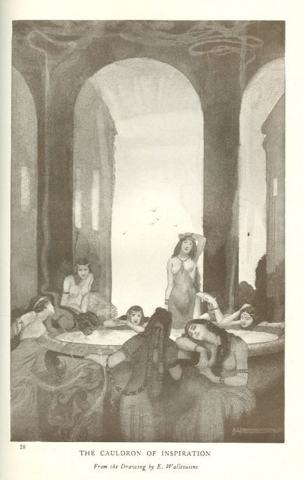
Wales's Otherworld — a rival kingdom ruled by Arawn, raided by Arthur for a magic cauldron, and only later flattened by Christian Welsh into a word for hell.
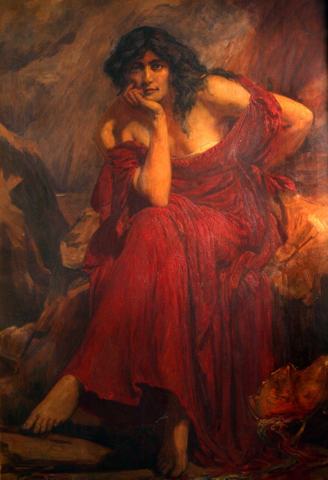
The Welsh enchantress who brewed a year-long potion of pure knowledge, chased the boy who stole it through a chain of animal shapes, and swallowed him whole.
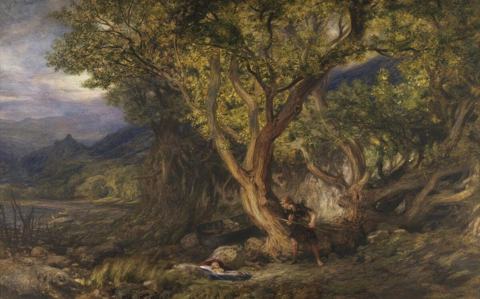
A real sixth-century court poet and a shapeshifting legendary bard reborn from a cauldron share one name, and the tradition never fully separates them.
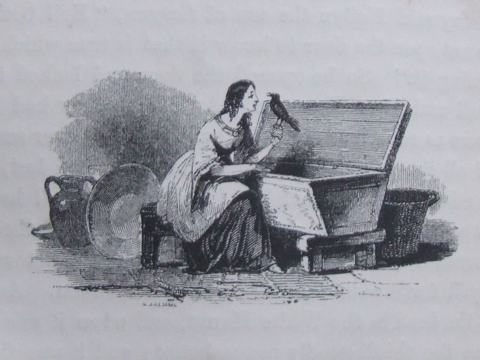
The giant king of Britain in the Mabinogi, too large for any house, who invaded Ireland to avenge his sister and whose severed head kept talking for decades.
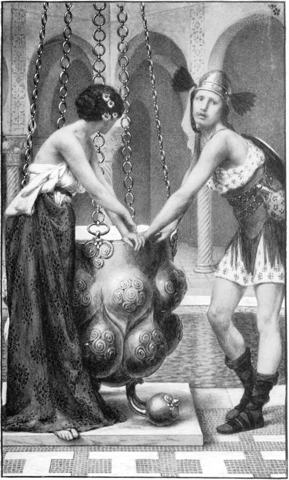
The horsewoman of the Mabinogi, wrongly accused of killing her son and forced to carry visitors on her back — probably, but not provably, a faded horse goddess.
An ordinary salmon that eats hazelnuts of wisdom from an otherworldly well and passes all knowledge on by accident, to the boy Fionn mac Cumhaill.
Sources & Further Reading
- 1.The White Book of Rhydderch (Llyfr Gwyn Rhydderch), National Library of Wales, Peniarth MS 4-5 (c. 1350).
- 2.The Red Book of Hergest, Jesus College, Oxford, MS 111 (c. 1382-1410).
- 3.Guest, Lady Charlotte, trans. The Mabinogion. 3 vols. Llandovery — William Rees, 1838-1849.
- 4.Davies, Sioned, trans. The Mabinogion. Oxford University Press, 2007.
- 5.Ford, Patrick K., trans. The Mabinogi and Other Medieval Welsh Tales. University of California Press, 1977.
- 6.Williams, Ifor, ed. Pedeir Keinc y Mabinogi. University of Wales Press, 1930.
- 7.MacKillop, James. Dictionary of Celtic Mythology. Oxford University Press, 1998.
- 8.Koch, John T. (ed.). Celtic Culture: A Historical Encyclopedia. ABC-CLIO, 2006.
Spot an error or have a source to suggest? Write to info@viseterna.com. We cite primary sources and modern scholarship, and we correct fast.