
Bran the Blessed
The giant king of Britain in the Mabinogi, too large for any house, who invaded Ireland to avenge his sister and whose severed head kept talking for decades.
Branwen and the starling, engraving by W. Williams (Lady Charlotte Guest's Mabinogion) · Public domain · source
A King Too Large for Any House
Bendigeidfran — "Bran the Blessed" — is king of the Island of the Mighty in the Second Branch of the Mabinogi, and the text establishes his scale immediately: no house has ever been built that can hold him, and at the story's crisis he wades the Irish Sea rather than boarding a ship, his warband sailing beside him while he walks the seabed with the water barely reaching his chest 1. He rules alongside his sister Branwen and brother Manawydan, children of Llyr, and two half-brothers of a different father, Efnysien and Nisien — one a source of trouble wherever he goes, the other a maker of peace between warring sides, and the narrative treats the contrast as load-bearing rather than incidental 1,2,4.
A Marriage, an Insult, and a Cauldron
The plot begins with a diplomatic marriage: Branwen is given to Matholwch, king of Ireland, to bind the two islands together. Efnysien, furious at not being consulted, mutilates Matholwch's horses at the wedding feast — cutting their lips, ears, eyelids, and tails to the bone — a calculated insult that very nearly collapses the alliance before it starts 1. Bran repairs the damage with new horses and an extraordinary gift: the cauldron of rebirth, which restores a dead warrior to life overnight, minus only the power of speech. The cauldron's own history folds Ireland back into the story before the war even begins — it had originally belonged to giants who fled Ireland for Britain and later returned there as part of the peace settlement, so that the weapon which sours the war is a graft from the very country it will be used against 1,5.
The War in Ireland
The peace does not hold. Matholwch's court, still smarting under the insult, demotes Branwen to the kitchens and beats her daily; she tames a starling, ties a message to its leg, and sends it across the sea to Bran 1. Bran invades with the cauldron's origin turned against its former owners: his forces cannot finally defeat an army that refills itself from the cauldron each night, until Efnysien hides himself among the Irish dead thrown in for revival, waits for the cauldron to begin its work, and then stretches his body until both he and the vessel burst apart, dying to destroy the one weapon keeping the war alive 1,4. The battle afterward is catastrophic on both sides. Only seven Britons survive, among them Pryderi, Manawydan, and the poet Taliesin — one of that figure's very few appearances in a narrative rather than a poem — and Bran himself is struck in the foot by a poisoned spear, a wound the text treats as fatal from the moment it lands 1.
The Talking Head
Knowing he is dying, Bran orders his own head struck off and carried home by the seven survivors, promising that it will go on speaking good company the whole way. The prophecy holds: at Harlech the seven feast for eighty years while Rhiannon's birds sing to them from over the sea, and for seven more years on the island of Gwales the head entertains them in an enchanted hall with one door they are forbidden to open. When one of them finally opens the door facing Cornwall, the spell breaks at once, grief and memory of everything lost return in an instant, and the survivors carry the head onward to be buried at the White Hill in London, facing France, as one of the "Three Fortunate Concealments" of Britain — a protection against invasion that lasts only until, according to the Welsh Triads, King Arthur digs it up out of pride, unwilling to defend the island by any power but his own 1,3.
Only Five Pregnant Women
Ireland's own casualty count closes the branch on a bleaker note than Britain's. The text reports that the war leaves only five pregnant Irishwomen alive, hiding together in a cave; each bears a son, and the five sons grow up and father children on each other's mothers, from whom the five provinces of Ireland are afterward said to descend — an origin story delivered in a single flat sentence, with none of the ceremony given to the British side of the same war 1,5.
Blessed, and Later Christian
The epithet Bendigeidfran, "Blessed Bran," sits oddly on a pre-Christian giant-king, and later medieval Welsh tradition supplies an explanation of its own: genealogies and triads outside the Four Branches credit Bran with bringing the Christian faith to Britain after being held hostage in Rome alongside his son Caradog, tying the mythic Bran to the historical first-century British leader Caratacus 3,6. Whether that connection is an old thread finally surfacing in later sources, or a late retrofit built to Christianise an already-blessed giant, is exactly the kind of question the surviving evidence cannot settle — and the Second Branch itself, indifferent to the question, simply ends with the head still talking 3,6.
Continue Exploring
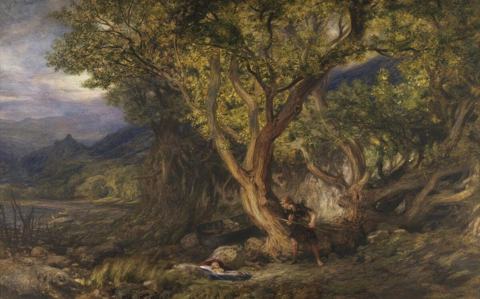
A real sixth-century court poet and a shapeshifting legendary bard reborn from a cauldron share one name, and the tradition never fully separates them.
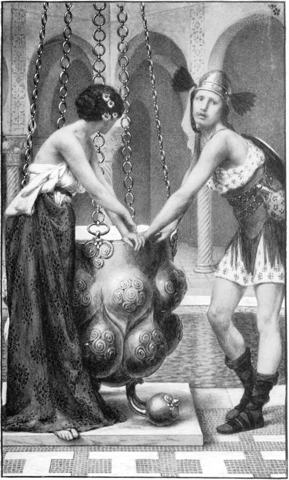
The horsewoman of the Mabinogi, wrongly accused of killing her son and forced to carry visitors on her back — probably, but not provably, a faded horse goddess.
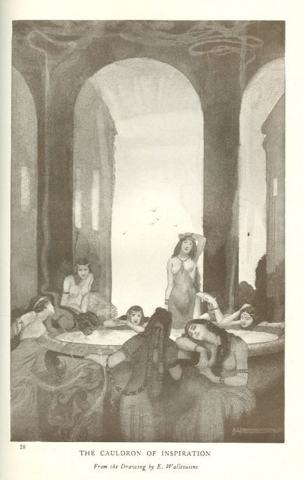
Wales's Otherworld — a rival kingdom ruled by Arawn, raided by Arthur for a magic cauldron, and only later flattened by Christian Welsh into a word for hell.
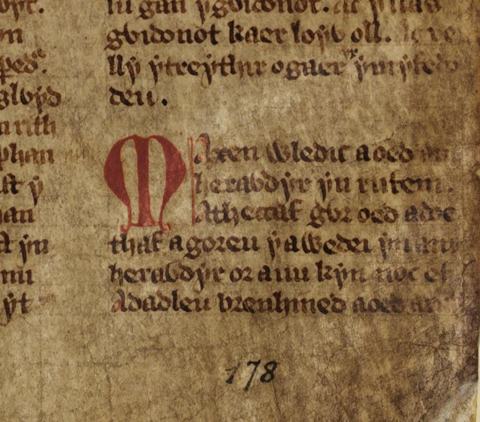
Eleven medieval Welsh tales — Four Branches, native stories, Arthurian romances — bundled under a title that scholars agree is a 19th-century mistake.
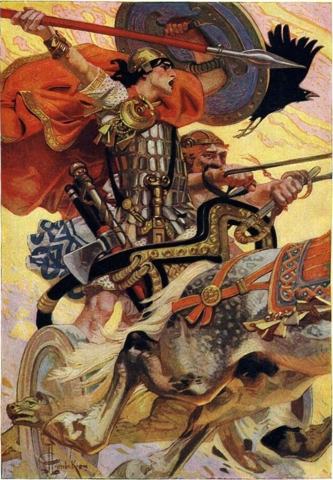
The Hound of Ulster — a boy-hero who holds an entire army at a ford, warps into a monster when he fights, and dies standing up, tied to a stone.
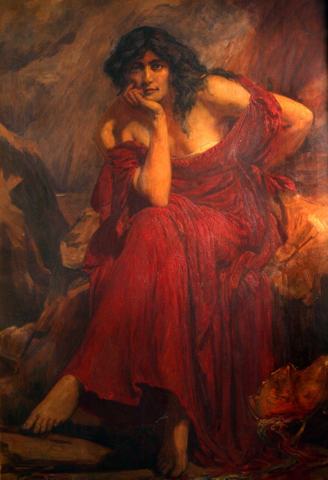
The Welsh enchantress who brewed a year-long potion of pure knowledge, chased the boy who stole it through a chain of animal shapes, and swallowed him whole.
Sources & Further Reading
- 1.Branwen ferch Llyr (Second Branch of the Mabinogi), Middle Welsh prose, in Sioned Davies, trans., The Mabinogion. Oxford University Press, 2007.
- 2.Williams, Ifor, ed. Pedeir Keinc y Mabinogi. University of Wales Press, 1930.
- 3.Trioedd Ynys Prydein (The Triads of the Island of Britain), ed. and trans. Rachel Bromwich. 3rd ed., University of Wales Press, 2006.
- 4.Ford, Patrick K., trans. The Mabinogi and Other Medieval Welsh Tales. University of California Press, 1977.
- 5.MacKillop, James. Dictionary of Celtic Mythology. Oxford University Press, 1998.
- 6.Koch, John T. (ed.). Celtic Culture: A Historical Encyclopedia. ABC-CLIO, 2006.
Spot an error or have a source to suggest? Write to info@viseterna.com. We cite primary sources and modern scholarship, and we correct fast.