
Rhiannon
The horsewoman of the Mabinogi, wrongly accused of killing her son and forced to carry visitors on her back — probably, but not provably, a faded horse goddess.
Pryderi and Rhiannon, Albert Herter, 1898, in Thomas Wentworth Higginson, Tales of the Enchanted Islands of the Atlantic, 1899 · Public domain · source
A Rider No One Can Catch
Pwyll, prince of Dyfed, has already survived a year ruling Annwn in the guise of its king when he sits one day on the mound of Gorsedd Arberth, a place where tradition holds that a nobleman who takes his seat there will either suffer a blow or witness a marvel. A woman in gold brocade rides past on a pale white horse, moving at an unhurried walk that no horseman can catch: Pwyll's fastest riders fall further behind the longer they chase her, on more than one day of trying, until Pwyll himself rides out, calls after her, and only then does she stop — informing him, not unkindly, that it would have been better for the horse if he had asked her to stop long before 1,3. She names herself Rhiannon, daughter of Hyfaidd Hen, tells him she has refused a match arranged with Gwawl fab Clud in order to marry him instead, and the two are wed after Pwyll wins her from Gwawl with a trick at the wedding feast involving a bag that can never be filled 1.
An Accusation and a Horse's Burden
Their son disappears from the birth chamber on the night of Calan Mai while Rhiannon's attendants sleep; to save themselves, the women smear her with the blood of a slaughtered puppy and accuse her of devouring her own child. Rather than let the charge stand untested, Rhiannon accepts a penance no court has actually handed down: for seven years she must sit by the horse-block outside the court gate, tell her story to every stranger who passes, and carry visitors into the hall on her back like a beast of burden 1. The child, meanwhile, has been rescued by the lord Teyrnon Twrf Liant, whose finest mare loses a newborn foal every May Eve to a monstrous clawed arm reaching in through the stable wall; the year Rhiannon's son vanishes, Teyrnon severs the arm, saves the foal, and finds an infant boy abandoned at his door. He raises the child as his own until the boy's face makes the truth impossible to miss, then returns him to Dyfed, ending Rhiannon's ordeal and giving the boy his name, Pryderi — "care" or "anxiety," from the word his mother speaks on getting him back 1,4. Ford points out that nothing in the Welsh calls Rhiannon's penance a legal verdict; it is a course she proposes herself, and the deliberate irony of punishing a woman introduced on horseback by making her play the horse has been noted by nearly every commentator since 4.
The Birds of Rhiannon
A separate motif follows her name outside her own story. Culhwch ac Olwen lists among the impossible marvels its hero must obtain "the birds of Rhiannon, that wake the dead and lull the living to sleep" 2. In the Second Branch, the seven survivors of Bran the Blessed's war in Ireland sit for eighty years at Harlech in a feast where no one ages and no grief is felt, entertained throughout by these same birds, singing from far out over the sea yet sounding as near as if perched on the hall itself — one of the most quoted images of enchantment in the whole of medieval Welsh writing 1. Rhiannon is not present in that scene and the text never explains the connection beyond the possessive; scholars generally take it as a sign that she carried a wider set of otherworldly associations than the plot of her own two branches spells out on the page 4,5.
Trapped Again in the Third Branch
Widowed, Rhiannon marries Manawydan, and the couple settle in Dyfed with Pryderi and his wife Cigfa. A sudden mist empties the land of every person and animal but the four of them, and when Pryderi and Manawydan go hunting, a strange white boar leads them to a fort that has appeared out of nowhere, containing nothing but a golden bowl hanging by four chains from a roof lost in shadow. Pryderi touches the bowl and cannot release his hands; Rhiannon comes looking for him, touches it too in trying to pull him free, and both are struck dumb and vanish with the fort itself, leaving Manawydan to farm the emptied country alone with Cigfa for years 1,3.
The enchantment turns out to be an old grudge repaid: it is worked by Llwyd fab Cil Coed, a kinsman of the Gwawl whom Pwyll once humiliated, whose men first ruin Manawydan's wheat disguised as mice. Manawydan traps the one slow, pregnant mouse he can catch and prepares to hang it as a thief, and is interrupted in turn by a priest, then a bishop, each offering to buy the mouse's freedom at a rising price, until the third visitor names himself as Llwyd and admits the mouse is his own transformed wife. Manawydan bargains her release, and his family's, for the lifting of every enchantment on Dyfed — and Rhiannon and Pryderi reappear as abruptly as they vanished, with no memory of anything beyond the touch of the bowl 1,4.
Horse Goddess? The Epona Question
Equating Rhiannon with the Gaulish horse-goddess Epona is an old habit, and in more romantic popular writing it is often stated as settled fact 6. The resemblance is real enough to invite it: Epona's iconography typically shows her among foals, and Rhiannon rides an uncatchable pale horse in her own introduction and is later sentenced to impersonate one. But the medieval Welsh text never calls Rhiannon a goddess, gives her no cult, temple, or worship of any kind, and no continental inscription ties her reconstructed name — from Brittonic Rigantona, "great queen" — to Epona or to any attested deity 4,6. Proinsias Mac Cana's influential reading cast her as a sovereignty or Otherworld goddess whose divinity had faded into a powerful Otherworld wife by the time the Four Branches reached their surviving form, a view widely repeated since; Koch's encyclopedia entry treats it as a plausible inheritance rather than a demonstrated one, and reads the Rhiannon of the text itself as an otherworldly noblewoman rather than a worshipped deity 6. The honest summary is that Rhiannon probably continues some strand of an older horse-associated figure attested more securely on the Continent, refracted through centuries of oral transmission into court prose — and that "probably" is carrying real weight in that sentence 4,6.
Continue Exploring
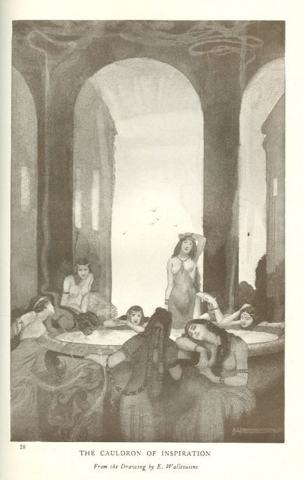
Wales's Otherworld — a rival kingdom ruled by Arawn, raided by Arthur for a magic cauldron, and only later flattened by Christian Welsh into a word for hell.
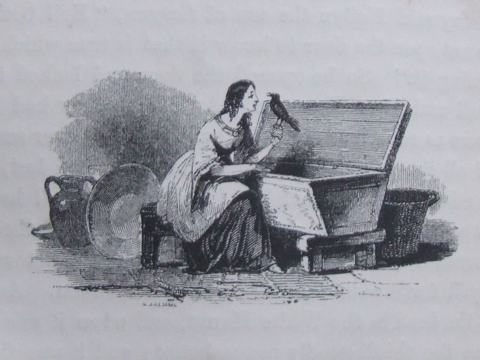
The giant king of Britain in the Mabinogi, too large for any house, who invaded Ireland to avenge his sister and whose severed head kept talking for decades.
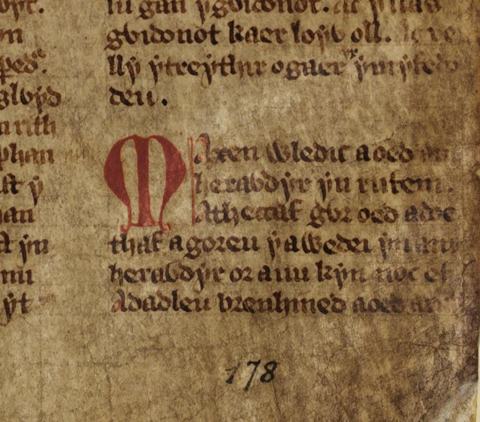
Eleven medieval Welsh tales — Four Branches, native stories, Arthurian romances — bundled under a title that scholars agree is a 19th-century mistake.
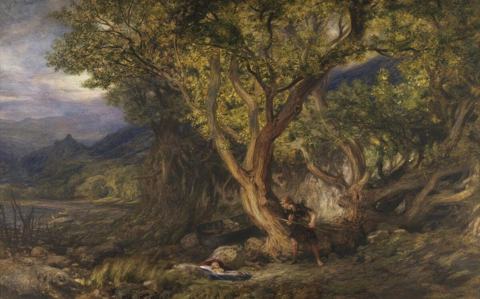
A real sixth-century court poet and a shapeshifting legendary bard reborn from a cauldron share one name, and the tradition never fully separates them.
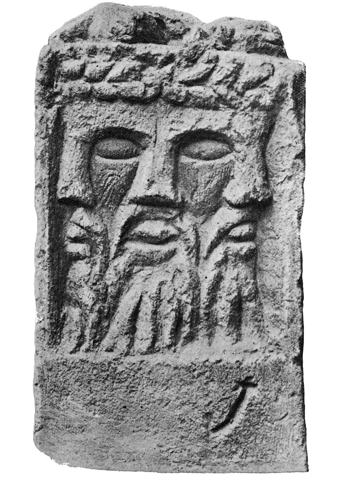
Master of every skill — the young god admitted to Tara because he alone could do all the crafts at once, and who killed his own grandfather Balor.
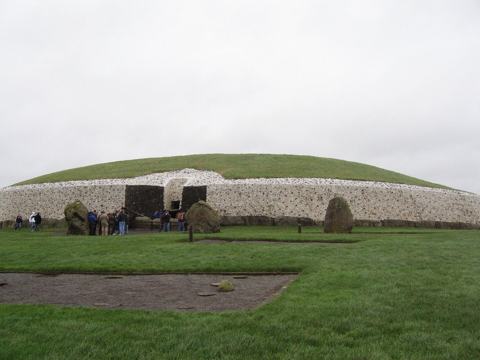
The good god — not morally good but good at everything: the club-bearing, cauldron-owning father figure of the Tuatha De Danann, and their crudest comedian.
Sources & Further Reading
- 1.Pwyll Pendefig Dyfed (First Branch) and Manawydan fab Llyr (Third Branch) of the Mabinogi, Middle Welsh prose, in Sioned Davies, trans., The Mabinogion. Oxford University Press, 2007.
- 2.Culhwch ac Olwen, Middle Welsh prose (c. 1100).
- 3.Williams, Ifor, ed. Pedeir Keinc y Mabinogi. University of Wales Press, 1930.
- 4.Ford, Patrick K., trans. The Mabinogi and Other Medieval Welsh Tales. University of California Press, 1977.
- 5.MacKillop, James. Dictionary of Celtic Mythology. Oxford University Press, 1998.
- 6.Koch, John T. (ed.). Celtic Culture: A Historical Encyclopedia. ABC-CLIO, 2006.
Spot an error or have a source to suggest? Write to info@viseterna.com. We cite primary sources and modern scholarship, and we correct fast.