
Ceridwen
The Welsh enchantress who brewed a year-long potion of pure knowledge, chased the boy who stole it through a chain of animal shapes, and swallowed him whole.
Ceridwen, Christopher Williams, 1910 (Glynn Vivian Art Gallery, Swansea) · Public domain · source
A Late Story About an Early Name
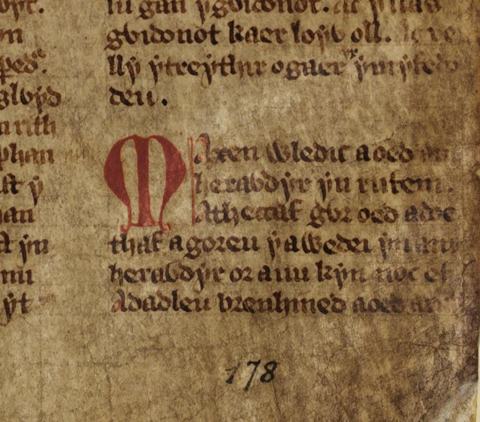
Ceridwen's name and her cauldron are older in Welsh tradition than the story that explains them. Poems in the Book of Taliesin, the verse manuscript behind much of Taliesin's legendary corpus, copied around the start of the fourteenth century but drawing on older material, refer in passing to "the cauldron of Ceridwen" as something a poet-speaker claims to have tasted or survived, treating the image as already familiar to an audience rather than introducing it 2,3. What those poems do not do is narrate the story. The full prose account — a woman brewing inspiration for her ugly son, a servant boy who steals it, a shapeshifting chase across a lake — survives nowhere before the chronicle of the Welsh soldier and scholar Elis Gruffydd, compiled in the middle of the sixteenth century, nearly a thousand years after the events it claims to describe and centuries after most of the poems that allude to the cauldron 1. Some scholars argue the tale's language and structure look considerably older than Gruffydd's own century, but the plain fact remains that no earlier version of the story itself has come down to us, and any account of Ceridwen has to hold both truths at once: an old name attached to a cauldron, and a late text explaining what the cauldron was for 1,5. When Lady Charlotte Guest translated The Mabinogion in the nineteenth century she added this tale as a twelfth story alongside the eleven that actually survive in the medieval manuscripts, which is one reason Ceridwen is now popularly filed under "Mabinogion" despite never appearing in the White Book of Rhydderch or the Red Book of Hergest at all 5.
The Cauldron of Awen
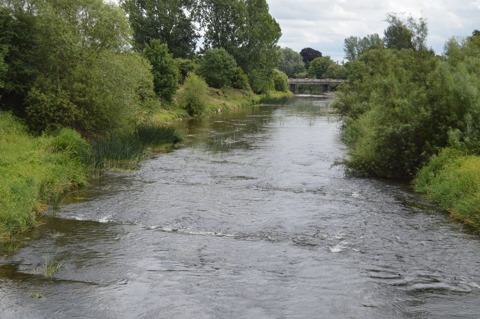
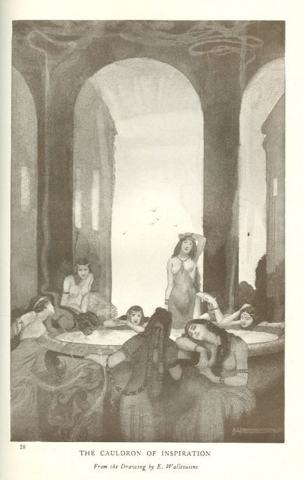
In Gruffydd's telling, Ceridwen is an enchantress living with her husband Tegid Foel beside Llyn Tegid, the lake in Gwynedd that still carries his name (Bala Lake in English). Their daughter Creirwy is famous for her beauty; their son, Morfran — also called Afagddu, "utter darkness" — is famous for the opposite, and Ceridwen resolves to compensate him by brewing a potion of total knowledge and poetic inspiration, awen, a process that requires the cauldron to boil for a year and a day without ceasing, tended constantly and stirred to the correct rhythm 1. She sets a blind man named Morda to keep the fire and a boy, Gwion Bach, to stir, while she gathers the herbs the working requires under the correct planetary hours, a level of ritual precision the text takes seriously as craft rather than as flavour 1,6.
Three Drops and a Chase
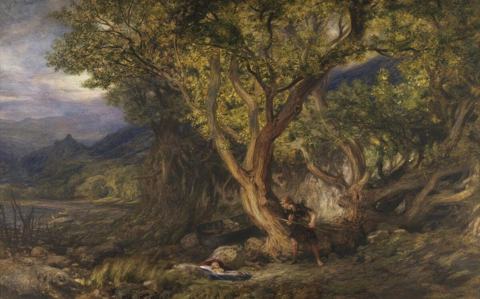
Right at the end of the year, three drops of the finished brew spit from the cauldron and land on Gwion's thumb; scalded, he puts the thumb in his mouth, and in that instant receives all the knowledge the potion held, while the rest of the liquid turns to poison and destroys the cauldron itself. Knowing at once what Ceridwen will do to him, Gwion runs, and the chase becomes a duel of transformations: he becomes a hare, she a greyhound; he a fish, she an otter; he a bird, she a hawk. Cornered at last, Gwion turns himself into a single grain of wheat on a threshing floor, and Ceridwen becomes a black hen and eats him 1. The sequence is the most vivid set-piece in the whole story, and Ford's translation preserves its speed: each shape is abandoned the instant it fails, with no pause for description, which is part of why the scene reads so much like older shapeshifting-pursuit material recycled into this particular frame 1,4.
Mother Again
Swallowing Gwion makes Ceridwen pregnant, and nine months later she gives birth to a boy so beautiful she cannot bring herself to kill him outright, though she knows exactly who he is. Instead she seals him in a leather bag and sets him adrift on the water on the eve of May. He is found, alive, caught in a salmon weir belonging to the unlucky nobleman Elphin ap Gwyddno, who unwraps the bag expecting fish and finds instead a radiant infant with a shining brow — which gives the child his name, Taliesin, "radiant brow," the poet whose birth this story exists to explain 1. Ceridwen herself exits the narrative at this point; the remaining chapters of Gruffydd's account belong entirely to Taliesin's career as a prodigy at Elphin's court and, later, at the court of King Maelgwn Gwynedd 1.
Ceridwen the "Witch," Then and Now
Later Welsh tradition and, more emphatically, twentieth-century Neopagan and Wiccan writing have promoted Ceridwen to the rank of a Welsh mother-goddess or "triple goddess" of magic, poetry, and the underworld, often paired with a horned consort and given ritual functions nowhere attested in the medieval material 5,6. That popular reading is a real and living tradition in its own right, but it should not be mistaken for what the sixteenth-century text actually says. Gruffydd's Ceridwen is called an enchantress skilled in magic and the arts, never a goddess, and no medieval Welsh source describes her being worshipped 1,4. What is not in doubt is her staying power as a figure for the raw, occasionally violent cost of inspiration: a full year of exact, unglamorous labour, consumed in an instant by someone else, followed by a pursuit that only ends when the pursued has nowhere left to turn into except food 1.
Continue Exploring
Eleven medieval Welsh tales — Four Branches, native stories, Arthurian romances — bundled under a title that scholars agree is a 19th-century mistake.
A real sixth-century court poet and a shapeshifting legendary bard reborn from a cauldron share one name, and the tradition never fully separates them.
An ordinary salmon that eats hazelnuts of wisdom from an otherworldly well and passes all knowledge on by accident, to the boy Fionn mac Cumhaill.
Wales's Otherworld — a rival kingdom ruled by Arawn, raided by Arthur for a magic cauldron, and only later flattened by Christian Welsh into a word for hell.
Master of every skill — the young god admitted to Tara because he alone could do all the crafts at once, and who killed his own grandfather Balor.
The good god — not morally good but good at everything: the club-bearing, cauldron-owning father figure of the Tuatha De Danann, and their crudest comedian.
Sources & Further Reading
- 1.Ystoria Taliesin (Hanes Taliesin), prose tale first recorded in the chronicle of Elis Gruffydd, mid-16th century; trans. Patrick K. Ford in The Mabinogi and Other Medieval Welsh Tales. University of California Press, 1977.
- 2.Legendary Poems from the Book of Taliesin, ed. and trans. Marged Haycock. CMCS Publications, 2007.
- 3.The Book of Taliesin, Middle Welsh verse, National Library of Wales, Peniarth MS 2 (early 14th century).
- 4.MacKillop, James. Dictionary of Celtic Mythology. Oxford University Press, 1998.
- 5.Koch, John T. (ed.). Celtic Culture: A Historical Encyclopedia. ABC-CLIO, 2006.
- 6.Green, Miranda J. Dictionary of Celtic Myth and Legend. Thames & Hudson, 1992.
Spot an error or have a source to suggest? Write to info@viseterna.com. We cite primary sources and modern scholarship, and we correct fast.